Scaffolding writing assignments enhances student learning and reduces teacher grading

Danielle Bradley with teaching award banner
Dr. Danielle Bradley (fourth from left) was recognized as one of the Teacher of the Year Finalists for Broward County Public Schools. Photo from the school district’s Twitter post.

by Dr. Danielle Bradley

Almost every teacher has heard the overwhelming and unanimous groans when announcing it’s time for students to write.

Writing assignments are not usually a crowd favorite, and often teachers struggle to make this instruction meaningful and even fun.

So how does the teacher avoid grading hundreds of unimpressive writing samples while also garnering buy-in from students? The answer is scaffolding writing lessons.

What is scaffolding?

Scaffolding in education is a technique that allows teachers to use various levels of support while helping students reach higher levels of comprehension and independence. In basic terms, scaffolding involves breaking up concepts or skills into smaller parts and then providing the assistance for students to learn each component.

Scaffolding lessons can be incorporated into any classroom K-12 or at the college level. This strategy works great with any curriculum and level of learner as well. Whether a new or veteran teacher, slowing down the pace of teaching challenging content is a win for the teacher and students.

Continue reading

Teaching: suggestions, advice and mentoring

For faculty the time between semesters includes reflecting on the previous semester, developing and revising courses, and adopting a few teaching resolutions.

Over the years, I have spent many hours during the breaks between terms updating class plans for the next term. I often read books, articles and blog posts related to teaching for inspiration and strategies.

So I read Shayla Love’s New York Times article on seeking and assessing advice — ”How Should You Be? Try Taking Suggestions” — with interest to see how her insights could apply to teachers.

Love’s article included her research on the origin of the suggestion box and interviews with five university faculty who study different aspects of advice – from communication science to workplace psychology.

One of the people Love interviewed was University of Chicago philosopher Dr. Agnes Callard. Dr. Callard discussed the differences between instructions, suggestions, advice, and mentorship. And all of these apply to reflecting on and improving your teaching.

Continue reading

Creating your teaching philosophy

What is the value of writing a teaching philosophy? And why is a teaching philosophy required in most faculty job applications and teaching award nominations?

Even experienced teachers say that writing a teaching philosophy can be difficult. Writing a teaching philosophy would be more challenging for graduate students, most of whom have been teaching for only a year or two. So why are teaching philosophies a required part of one’s teaching career?

During my faculty career at the University of Florida, I was fortunate to teach a pedagogy course for graduate students in the College of Journalism and Communications. I really enjoyed working with the graduate students to help them develop and expand their teaching competencies and their outlook on teaching and learning.

As a major assignment for the course, the students developed a teaching portfolio to be used in applying for faculty positions. The portfolio included their created instructional materials, a syllabus, and a teaching philosophy.

As a current member of UF’s Graduate Student Teaching Awards Committee, I’m reading some very effective teaching philosophies that are part of their nomination portfolios.

Writing a teaching philosophy can help you look at the big picture

Developing a teaching philosophy can help determine how you view your students, structure your course, and present as a teacher.

Let me share a few examples from some of the candidates (and some winners) for the Graduate Student Teaching Award.

Continue reading

Promoting your new college course

The new academic year is starting at almost 4,000 colleges and universities around the country. What will make this a special year for many faculty is offering a new course that they have developed.

Typically when you develop a new course, you are excited about exploring and teaching a new topic and sharing a great learning experience with your students. But that excitement can turn to disappointment when you find that only a few students have registered for the course, and your course is cancelled because it doesn’t have the required minimum number of students.

Let me offer some suggestions for promoting your course based on my own experience in creating new courses and from my experience serving on the University of Florida’s General Education Committee and the College of Journalism and Communications Curriculum Committee.

Don’t count on the course to draw students without your active involvement in promoting the course. Even if you have developed a great course, the first time you offer a course, you are likely to have some difficulty attracting students.

Your new course probably isn’t listed in the university’s catalog and may not be included in your college’s advising materials. So students may not be aware of the course.

Continue reading

University of Florida Graduate Student Teacher Award winners for 2021-2022

UF Graduate Student Teaching award winners2021-2022
Graduate Student Teaching Award winners and members of the Selection Committee. Photo by Eric Zamora

Congratulations to the 19 graduate students who were selected as the University of Florida Graduate Student Teaching Award winners for 2021-2022.

Award Winners

Pearis Bellamy – Psychology
Recep Celebi – Mathematics
Savannah Gramze – Astronomy
Joseph Hoft – Sociology and Criminology
Haley Johnson – Theatre and Dance
Lindsay Lloveras – Psychology
Nicolas Macaluso – Chemical Engineering
Ioannis Michaloliakos – Physics
Cristovão Nwachukwu – English
Emily Pappo – Natural Resources and Environment
Anthony Smith – Classics
Ar’Darius Stewart – Theatre and Dance
Nathaniel Strauss – Physics
Nieves Villaseñor III – Music
Anita Walsh – Economics
Lauren Weisberg  – Teaching and Learning
LingQin Xue – Physics

Calvin A. VanderWerf Winners

Leandra Merz – Geography
Hank Samuels – Teaching and Learning

Continue reading

Colleagues create textbook during pandemic

Published! Middle Tennessee State University colleagues (from left to right) Dr. Sally Ann Cruikshank, Dr. Keonte Coleman and Dr. Christine Eschenfelder pose with their newly published textbook in the  School of Journalism and Strategic Media’s student news studio. Photo by Dan Eschenfelder

When I received word from Dr. Christine Eschenfelder that she and two of her Middle Tennessee State University colleagues had written a textbook during the pandemic, I wanted to hear how they did it.

Dr. Eschenfelder, Dr. Sally Ann Cruikshank and Dr. Keonte Coleman, all faculty in the School of Journalism and Strategic Media, were motivated to write “A Complete Guide to Television, Field, and Digital Producing” to fill a need in the curriculum in their school and in other communication programs.

During the pandemic, they developed the concept for the book, secured a publisher, and wrote the book, in spite of all the disruptions caused by the pandemic.

I asked the three to share their experiences in writing the book.

Dr. Christine Eschenfelder is an associate professor and recipient of the MTSU Outstanding Teaching Award and broadcast industry awards. Her research focuses on broadcast journalism education, newsroom diversity, and women in broadcasting.
Twitter: @cceschenfelder

What inspired you and your two colleagues to write “A Complete Guide to Television, Field, and Digital Producing”?

We all worked in television news before our careers in academia. I was an on-air reporter and producer. Sally Ann and Keonte were also producers. Television news producers are in great demand. It’s an important and exciting job that many students don’t know about.

Continue reading

Librarians assist faculty in using Open Education Resources (OER) and library-licensed materials

When you design a new course or update a course you’ve previously taught, consider talking with your librarian to help identify course resources.

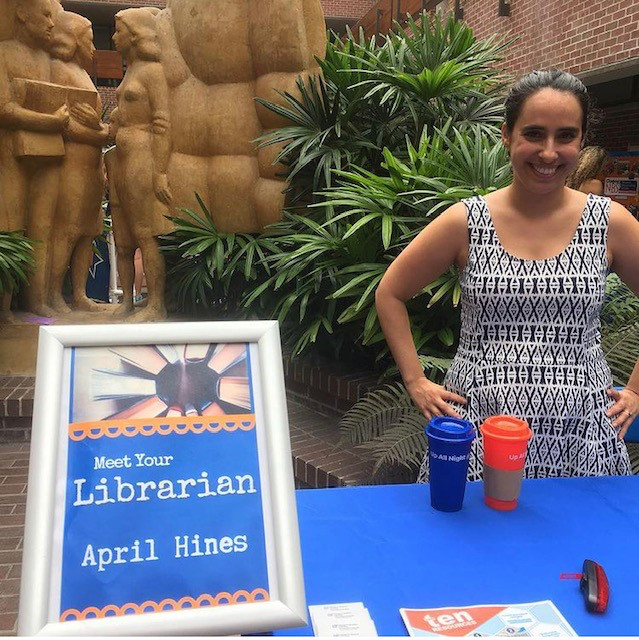
April Hines
April Hines encouraged library use during the Student Involvement Fair, held in the courtyard of the College of Journalism and Communications.

I asked April Hines, librarian for the University of Florida College of Journalism and Mass Communications, to share insights about the work of librarians and how librarians can enable faculty to utilize Open Educational Resources (OER) to provide up-to-date, free course materials for students.

Hines is chair of the Education and Behavioral Sciences Section (EBSS) of the Association of College & Research Libraries (ACRL), a division of the American Library Association (ALA). She earned a bachelor’s degree in Journalism from UF and a master’s degree in Library and Information Science from the University of South Florida.

Faculty often think campus librarians are solely focused on helping students who are in the library. What are some of the ways you are involved in helping faculty? 

April Hines: Much of my work happens beyond the physical library space – especially during COVID-19. Faculty will often ask me to be a guest speaker in their classes (either in person or virtually) to teach specialized research skills or to discuss topics related to information or media literacy.

Continue reading

Improve class discussions with Bloom’s Taxonomy

So many class discussions could become an improved learning experience for students with a little more guidance from the instructor.

That assessment is based on observing classes as a member of the University of Florida Graduate Student Teaching Awards Committee.

I’ve been listening to class discussions in a wide range of disciplines – psychology, educational technology, acting, kinesiology, history and microbiology to name just some.

Some instructors have led probing insightful discussions, but many discussions remained at a superficial level.

The instructor posed a good opening question that often results with a student providing a very concise “correct answer.” The instructor validates the student’s response but often moves on rather than digging deeper into that correct answer.

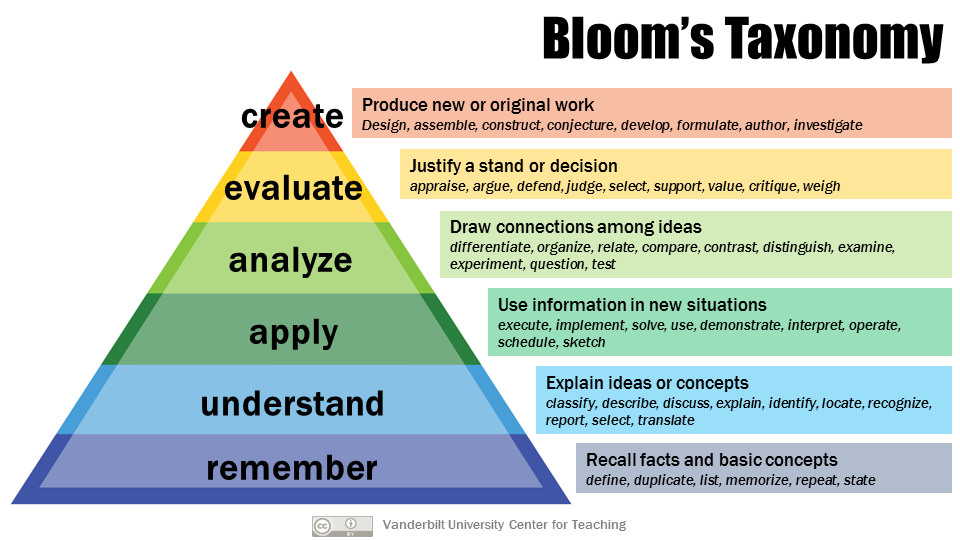
Bloom’s Taxonomy is a good reference for designing questions to guide small-group or full-class discussions. The taxonomy originally was published in 1956 by a team of University of Chicago cognitive psychologists and named after Benjamin Bloom who was the committee’s chair.

Continue reading

Teach with Zoom breakout rooms

Zoom breakout rooms are a teaching tool being used more frequently as universities invest in the application and as instructors become more familiar in setting up and using the breakout rooms.

Zoom image

Having students work in breakout rooms can provide a change of pace in class and enable more students to engage actively in class.

As a member of the University of Florida’s Graduate Student Teaching Awards Committee, I have observed graduate students utilizing Zoom breakout rooms in a wide range of subject areas. Whereas instructors typically only make brief visits to breakout rooms during class, I have been able to observe the full time students are in a breakout room.

Based on my observations, I’m offering a few suggestions for using Zoom breakout rooms.

Develop an effective breakout room assignment.

Creating a good breakout room assignment is like creating a good small group discussion activity for face-to-face classes. Consider what a small group discussion will accomplish in a more productive way than a full-class discussion.

Continue reading

Covid-19 and teaching advice

I’ve been part of the University of Florida’s orientation for new teaching assistants for a number of years. My topic has been advice for having a successful start to the school year.

Dr. Julie Dodd speaks at UF TA orientation 2019

This was what my presentation looked like at the 2019 orientation for new teaching assistants. Photo by Daniel Brotherton

Prior to this year, the 400 new teaching assistants would meet in a large auditorium for the orientation.

Due to Covid-19, this year’s orientation went online.

Over four days, part of the orientation was held live via Zoom, with about 100 different TAs attending each day.

Dr. Julie Dodd presents at UF TA orientation 2020

This is what my presentation looked like for the 2020 TA orientation. Click on the link at the end of the post to watch the video.

The other portion of the orientation, which included my presentation, were recorded videos. (At the end of this post you can click on a link to watch the video.)

In creating my presentation, I considered what would be helpful advice for starting a school year in a pandemic.

Continue reading