
Provide feedback students will use

by Julie Dodd

“I spend so much time providing my students with helpful feedback on their big project, and they don’t read it.”

I imagine you’ve heard colleagues say that and may have said that yourself.

grading papersHaving grappled with getting my students to read and use my feedback, I’m offering a suggestion:

Provide the most feedback when students are the most interested in receiving it – when they can use your feedback to improve their grade.

Often we provide extensive feedback on a research paper or final project when the assignment is completed. So no matter how useful our feedback may be, the students aren’t able to use the feedback to improve their grade on the assignment.

Continue reading

Encouraging student involvement in college classes

by Julie Dodd

Why are some students ready to answer every question while other students are silent throughout the class?

Quiet book cover

Susan Cain’s book can help teachers better understand their students who are introverts.

As a member of the University of Florida’s Graduate Student Awards Committee, I have the opportunity to observe a wide range of classes, including Mindful Leadership, Cities of the World, and Expository and Argumentative Writing. I’ve observed classes with more than 200 students and classes with fewer than a dozen students.

The eager to talk students and reticent to talk students exist in every classroom setting.

Getting students actively involved in college classes is a goal to promote more effective learning.

So how can you get students to participate?

I recently observed a sociology class with 26 students. During the 50-minute class period, 14 different students talked – asking questions, answering questions, or sharing insights.

The graduate student teaching the sociology class did a good job of getting half the class to participate. Here are strategies she used to promote class involvement:

Continue reading

5 New Year’s resolutions for college instructors

by Julie Dodd

As you start a new term as a teacher, you should be considering what your goals are for this new term.

Let me offer a few suggestions:

#1 – Don’t set too many goals for yourself.

If you are getting ready to teach a course you’ve taught before, you’ve probably identified a number of areas that could improved. You want to include a group project. You want to develop your own test questions instead of relying exclusively on the test bank provided with the textbook. You want to include more relevant video clips. You want to update some of the examples you use in class.

All of those can be worthy goals, but you need to consider the amount of time that is involved in each of those improvements.

For example, including a successful group project is much more than simply adjusting the students’ grades to incorporate that assignment. You will need to read about structuring group projects and then make additional small-stakes assignments that lead toward the final group project. You’ll need to include class activities to build group teamwork skills. [Read a previous post about strategies for designing group projects. ]

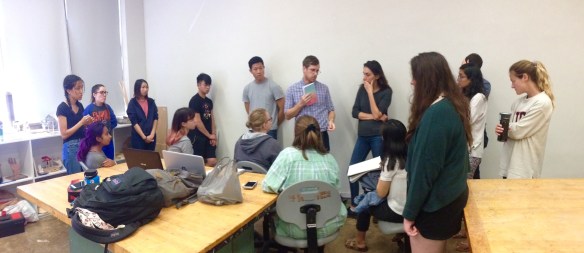
group project critique

A critique session with the instructor, a subject area expert and classmates is part of the group project experience for Morgan Yacoe’s Art, Body, Health: Visual Arts and Healthcare Collaboration course at the University of Florida.

You want to make improvements to your teaching, but don’t take on so many goals that either you are overwhelmed or you don’t do a good job in what you set out to improve.

Continue reading

5 tips for structuring and grading group projects

Being able to work effectively in a team setting is an important skill in many jobs. So to help students develop the ability to work in a team, many college courses incorporate group projects. If you’ve used a group project in a course you’ve taught, you know that successful group work doesn’t just happen. Krystin Anderson offers advice on how to develop effective group projects.

by Krystin Anderson

Krystin Anderson

Krystin Anderson

So you want to use a group project for your students.

If you feel some apprehension about using group projects, you are not alone! Group projects can cause anxiety for teachers and students alike, both of whom are afraid that what is meant to be a positive, collaborative learning opportunity will become a nightmarish conflict of personalities and interests resulting in tears and failure.

(Click College Rant: I hate group projects for one student’s musings.)

However, group projects offer opportunities for students to complete something they could not on their own, not only because of the time constraints within a semester but because a single student may not have the all skills that a group of students could bring together.

Group projects also help students learn how to work in groups and to become interdependent—a skill most media professionals use frequently throughout their careers.

Continue reading

Changing your course syllabus as you are teaching the course

by Julie Dodd

How much can I change the syllabus while the course is underway?

That’s a question that I’ve been asked when I lead workshops for teaching assistants and new faculty.

uf-syllabi-websiteEspecially when you are teaching a course for the first time, it’s difficult to know if you are creating the right course design.

  • Do the students have the academic background that you thought they would?
  • Have you allocated enough time for major assignments and projects?
  • Did you include enough time in class for you to present the key concepts and to provide time for students to engage in active learning activities?

You get weeks (or maybe just a few class sessions) into the course and realize that you would like to change the syllabus.

I’m a big advocate of syllabus assessment and redesign. However, I’d strongly recommend that during the term you are teaching the course, you should give careful consideration before making any significant changes to the course, such as eliminating a major assignment or test or adding an additional unit or project.

Continue reading

Teaching strategies: Responding to Hurricane Florence (and other disasters)

by Julie Dodd

As a professor at the University of Florida, I’ve experienced several major hurricanes  during the academic term and know how such disasters can impact students and course plans.

Hurricane Florence imageI’d like to offer a few suggestions for instructors who are now dealing with the impact of Hurricane Florence — or for instructors who have to deal with other kinds of disasters that affect your students and your classes.

Keep up to date with your university’s policies regarding the emergency.

Universities typically are prompt in sending announcements to faculty about developments in response to a disaster – when the university is closed, what resources are available, etc.

If you’re an adjunct faculty member or a teaching assistant, you may not be receiving those announcements. Be sure to check the university’s website and ask a faculty member to keep you up to date with developments.

Realize that a major disaster, like Hurricane Florence, will affect students in many different ways — from emotional to financial.

Students in the path of a hurricane may have had their apartments or residence halls flooded and lost all their belongs, including laptops, textbooks and class materials.

Continue reading

Teaching advice: Syllabus design and strategies for starting the school year

A view from the back of Carlton Auditorium during the orientation for UF’s new teaching assistants.

by Julie Dodd

Julie Dodd at UF TA orientation

In small classrooms or large auditoriums, I like to include ways for students to be active participants in class. Photo by Ashleigh Kathryn

“A Positive Start to Your Teaching: Your Syllabus and the First Week of Classes.”

That was my topic for the the Orientation for Graduate Teaching Assistants at the University of Florida.

More than 400 new TAs spent the day at the orientation that was designed to help them be better prepared to take on their new teaching duties when classes start next week.

Continue reading

Effective transitions between classroom activities

by Julie Dodd

As instructors, we’re often so focused on the content of the lesson that we don’t think about the importance of structuring effective transitions between different segments of the class.

students editing in computer lab

Having students work in pairs or small groups promotes active learning. But it’s important to plan your transition between activities to make good use of class time.

A reader of my blog who is a math teacher noted that lack of smooth transitions can lead to losing class time or even losing students’ attention for the rest of the class.

That comment motivated me to share some tips about structuring transitions between classroom activities.

Continue reading

Tips for designing a college course

by Julie Dodd

Designing a course is one of the challenging and rewarding parts of teaching and can enable you to combine successful learning ideas and approaches from other instructors with your own teaching insights and skills.

Let me suggest four strategies for developing college courses and recommend readings that can help you dive deeper into thinking about instructional design.

#1 – Consider the big picture of your course

Before you select a course textbook or start inviting guest speakers, step back and consider the big picture of your course.

collage of book covers on teaching advice

Add these four books to your reading list to help you develop strategies for designing courses and improve your teaching.

Start with the goals of the course.

Those may be provided in the form of Student Learning Outcomes (SLOs), which are a list of what students should be able to do by the end of the course. Sometimes the goals are included in the college’s or department’s curriculum standards and sometimes stated in the syllabus that has been used previously for those teaching the course.

If you teach a course that is part of a sequence of courses, you can talk with an instructor of the course students take following the course you are teaching to see what the expectations are of students coming into that course after completing your course. (And those should align with the SLOs for both courses.)

Continue reading

Tips for choosing college textbooks for classes you teach

by Julie Dodd

An important part of your success as an instructor is based on the books and other materials you select for students to use as part of your course.

Good textbooks and online readings can help students be both better prepared for class and provide some of the instruction.

Barnes & Noble screen capture

Barnes & Noble and Follett are two of the companies that operate many college bookstores. As of March 2018, Barnes & Noble College operated bookstores on more than 780 campuses in the US.

Selecting a weak textbook or requiring too many textbooks can lead to students being overwhelmed which can be reflected in the students’ participation in class, academic performance, and the evaluations they give you at the end of the semester.

Let me offer ten tips for selecting textbooks and other course materials (i.e., online readings, textbook online resources).

Tip #1 – Determine the purpose of the textbook

Remember that the book is not the creator of the course – you are. The book (or other materials) should support your approach to the course. Finding a textbook that will include everything you’d want – and in the way you’d want it presented — probably will be impossible, unless you write the textbook yourself.  Look for materials that support what you are doing that provide a good background, examples and illustrations.  Consider the following questions when considering a textbook:

  • Does the book provide foundation information for the course?
  • Will the book provide assignments, exercises, labs, or case studies for student practice or assessment?
  • Does the book provide a point of view or different points of view that contribute to a broader understanding of issues involved in the course?

Continue reading