Teaching online: Strategies and tips for college instructors

by Ernest Rice
Ph.D. student, University of Florida

Ernest Rice

Ernest Rice

If you haven’t taught an online course yet, you probably will be sometime soon.

In 2012, the US Department of Education estimated that 6.7 million students were enrolled in online classes in the US, while the number of online classes as well as online only degrees is growing constantly.

Online education began as distance learning, which is a way of educating students who are not in the physical presence of the instructor.

Distance education as we know it began in England in the 1840s when Sir Isaac Pitman started promoting correspondence courses on shorthand in newspaper advertisements as well as through door to door sales.  In the 1920s and 30s several schools experimented with distance learning using radio where students listened to lectures and mailed-in assignments. In the 40s U.S. military troops were shown training films and movies, and in the 50s and 60s television was used to do the same thing.

Continue reading

Teaching to support the diversity of the 21st Century college classroom

by Gabriel Stephen
Ph.D. student, University of Florida

Gabriel Stephen

Gabriel Stephen

Think for a moment about your cultural identity, think about the icons and seminal events that molded your generation: the iPhone frenzy, the September 11 terrorist attacks, Muhammad Ali lighting the Olympic torch in Atlanta.

Now consider the traditions or rituals that you grew up with that still resonate with you today: Thanksgiving dinner, the National Anthem before sports contests, the Nathan’s Hotdog Eating Contest on Independence Day.

What do you think about those examples? How did your perspectives compare? The truth of the matter is that even within certain nationalities, ethnicities, and cultures there are fundamental differences in experience – this is diversity.

Continue reading

Discipline problems in college classrooms: Strategies on how to avoid or address

by Robert H. Wells
Ph.D. student, University of Florida

Robert H. Wells

Robert H. Wells

Discipline is a concern for all college instructors at some point in their career. Having an idea of some common discipline problems, as well as possible solutions to them, will help mitigate the problems when they occur as well as help instructors reduce the anxiety they may have about disciplining students.

Four common types of discipline problems are: academic dishonesty, attendance, distracting behavior and aggression.

This post will focus on the latter three, as academic dishonesty is discussed in a separate blog post. At the University of Florida, academic dishonesty must be taken seriously and reported to Student Conduct and Conflict Resolution, a part of the Office of the Dean of Students.

Continue reading

Providing Remediation: How College Professors Can Help All Students Succeed

by Earlesha Butler
Ph.D student, University of Florida

Earlesha Butler

Earlesha Butler

Offering remediation, or academic assistance, to students is nothing new for state and private universities. Because some states have cut or reduced funding for student remediation, students who’d typically enroll in fundamental classes to enhance their academic skills are now in courses with peers who may be advanced.

Federal statistics show that 19 to 26 percent of all college freshmen require help to overcome remedial needs, according to the Education Commission of the States – an organization that follows policy updates.

The reasons students may require more academic help vary. For example, students may have scored below average on national exams like the ACT or SAT. Or, students may need additional academic assistance because they’re first-generation college students, which mean no one in their immediate family is a college graduate. These students tend to have no one in their families to rely on for help and they may loose motivation or quit school altogether, due to lack of support. Lastly, life disruptions happen and college students fall behind in their schoolwork. So college professors have to be ready to provide help as needed.

Continue reading

Experiential education enhances active learning for college students

by Baobao Song
Ph.D. student, University of Florida

Tell me and I forget, teach me and I remember, involve me and I will learn.
                                        — Benjamin Franklin

Baobao Song

Baobao Song

Experiential education is a major approach to create immersive experience for students and encourage active learning in higher education. According to Association for Experiential Education (AEE), experiential learning is “a philosophy and methodology in which educators purposefully engage with students in direct experience and focused reflection in order to increase knowledge, develop skills, and clarify values.” The definition has two implications for instructors:

  1. Grasp knowledge through direct experience: Use ill-defined, complex, real-world situations, problems, or actions to the extend possible.
  2. Transform knowledge through focused reflection: Offer feedback to students and encourage self-evaluation and retrospection.

Continue reading

Your Friend, The Rubric — How rubrics can assist you as a college instructor

by Rich Shumate
Ph.D. Student/Teaching Assistant, University of Florida

Rich Shumate

Rich Shumate

Rubrics can an effective tool to use for assignments that are being assessed subjectively, including writing assignments, term papers, performances, photography or artwork, and journalism.

Even though you are grading subjectively, rubrics can provide structure to your grading to make is less subjective.

Rubrics also provide consistency to your grading, which makes if fairer for students.

Continue reading

Tips for using videos to enhance college teaching and learning

by Kelly Flowers-Rose
Ph.D. student, University of Florida

Kelly Flowers-Rose

Kelly Flowers-Rose

Undergraduate students have an attention span on average of 20 minutes. Therefore, college instructors need to be able to engage these students by interspersing different teaching techniques. These can include, but are not limited to, class discussion, small group work, written assignments or use of videos. By using videos in higher education classes an instructor can

  • Reinforce reading and lecture material
  • Aid in the development of a common base of knowledge among students
  • Enhance student comprehension and discussion
  • Provide greater accommodation of diverse learning styles
  • Increase student motivation and enthusiasm
  • Promote teacher effectiveness

The rules governing use of video materials for face-to-face teaching provide more flexibility concerning copying, displaying, and distributing copyrighted materials in the classroom  — http://www.baylor.edu/copyright/index.php?id=56543#classroom.

You may show a video in your class without obtaining permission by conducting a fair use evaluation. A quick evaluation to determine if videos you would use in your classroom should meet ALL the following requirements:

Continue reading

Knowing your students can help you be a more effective teacher

by Julie Dodd

nyt_cover_wAn important part of developing an effective undergraduate course is knowing your students.

Why are students taking your course?
Is this a required course? Is the course a prerequisite for another course students want or need to take?

What academic background are students bringing into your course?
What courses have they had at the college level before taking your course? What courses did they have in high school? And we, as college teachers, need to be aware that every student — even if they have the same course on their high school or community college transcript — has not had the same learning experience.

Continue reading

Planning is key step for effective teaching — advice to new teaching assistants

University of Florida's New Teaching Assistant Orientation

More than 400 University of Florida graduate students attended the New Teaching Assistant Orientation, held in Carleton Auditorium. Photo by Julie Dodd

by Julie Dodd

The more than 400 new teaching assistants at the University of Florida have been busy preparing for the start of school by attending the New Teaching Assistant Orientation. I enjoyed being part of the team of faculty members, administrators and teaching assistants who made presentations for the orientation.

My presentation was “A Positive Start to Your Teaching: Your Syllabus and the First Week of Class.” You can download the PDF handout of the slides (5MB) – dodd_2014_UF_TA_orientation_slides

[You can check the UF Teaching Resources tab at the top of the blog for a list of links to helpful teaching resources, including syllabus policies and the UF Undergraduate Catalog.}

I appreciated everyone participating in the short peer-to-peer discussions on topics related to teaching. Thanks to those of you who asked questions, which included:

  • What activities can you use to learn student names?
  • What are tips for international teaching assistants for whom English is not their first language?
  • What advice do you have for how to avoid discipline problems that can be caused by cellphones?

Preparing for the presentation is always helpful for me, as talking about planning for teaching success helps me in my own class planning.

Thanks to Drs. Paul Duncan, Winifred Cooke and Rhonda Moraca for coordinating such a helpful program. For more information on support for teaching assistants (including the “Teaching at the University of Florida” handbook), check the UF Teaching Center.

9 tips for improving your course syllabus — and the way you teach the course

by Julie Dodd

students editing in computer lab

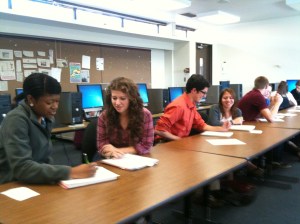
Think about how you can get your students more actively engaged in class. Peer work can be a way of helping students better understand course content. Here students in a writing course I teach, provide feedback on a writing assignment.

Colleges and universities around the country will be starting a new academic year in the next few weeks. Students and their parents will be arriving on campus with carloads of boxes to move into residence halls.

Campus maintenance crews are preparing the grounds, and construction teams are trying to finish campus remodeling and building projects.

And faculty, adjuncts and graduate students are planning their classes. Now’s the time to do some thinking that can improve the course — making it a better learning experience for your students and a better teaching experience for you.

1. Reflect on how the course contributes to the students’ big picture of learning

Salman Khan, in his One World Schoolhouse: Education Reimagined, reminds us as educators that students become more engaged in learning when they see the value of the course beyond preparing for an exam or completing a graduation requirement.

Especially if you are teaching an introductory course, help the students connect with the value of that subject area. Your approach to the course could help some students decide to take more courses — or even major — in the field. For the other students, they will have a better understanding of the concepts as they connect to life issues.

2. Align SLOs with course content – readings and assignments

Especially the first time you teach a course and especially for new faculty members, the tendency is to select a good textbook and then structure the course to match the textbook chapters.

Start first with what the Student Learning Outcomes are for the course – which you may be determining but also may be determined by the overall curriculum structure. In Understanding by Design, Grant P. Wiggins and Jay McTighe explain the process for mapping out a course — starting first with the student outcomes and then designing appropriate activities and assignments.

Continue reading