
5 ways teaching helped me be more effective in making a conference presentation

Arthur Leal
Ph.D. student, University of Florida
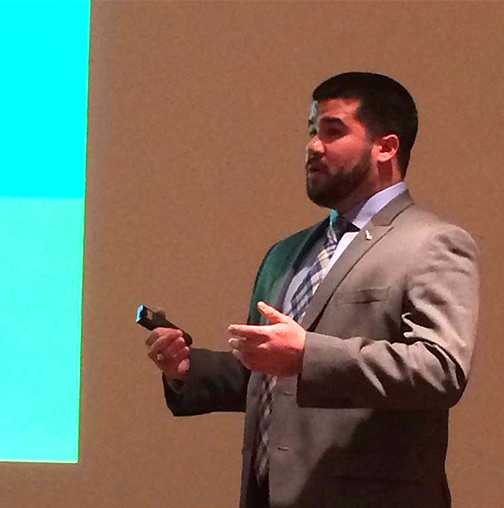
Arthur Leal

Arthur Leal presents at the Southern Association of Agricultural Scientists conference.

I had the opportunity to present at the Southern Association of Agricultural Scientists (SAAS) conference this semester about a month after I started as lead lecturer for Research and Business Writing, an undergraduate course at the University of Florida.

I imagined my teaching experience helping me in better preparing to present at SAAS. My teaching experience did help me even though the audiences were quite different.

Presenting in front of undergraduate students is quite different than presenting in front of colleagues and faculty members. Nonetheless, I still managed to extend my classroom experience into my presentation at my conference and learn how the two overlapped.

To set the stage for my conference presentation, imagine an auditorium that seats about 100 people. The auditorium was a formal setting with a horseshoe-shaped arrangement. The lighting was slightly dimmed, and there was a podium and projector available for the presenter. There were approximately 30 plus individuals present for the presentation: faculty, staff, professionals and graduate students.

Continue reading

Strategies for promoting cultural diversity in college classes

by Linwan Wu
Ph.D. student, University of Florida

Linwan Wu

Linwan Wu

Cultural diversity in classroom involves two important aspects: one is to help international students adapt to American cultures, and the other one is to encourage all students to respect cultural diversity.

International students’ cultural-related problems:
(1) Social customs
(2) Language problems
(3) Culture shock

How to help international students in your courses:
(1) Help international students understand “culture is relative.”
(2) Encourage them to be open-minded.
(3) Ask them to use their communication skills.
(4) Encourage them to ask questions.
(5) Help them to find a cultural ally.

Continue reading

Strategies for creating multiple-choice test questions

by Julie Dodd

students taking exam in auditorium

I took this photo from the back of the auditorium, while my 130 students were taking an exam. Photo by Julie Dodd

Which of the following is correct about multiple-choice testing?
(A) Multiple-choice questions are easier to write than essay questions.
(B) If you don’t like multiple-choice tests, you won’t ever have to use them as a teacher.
(C) Multiple-choice tests can measure all student learning objectives.
(D) Students like talking multiple-choice tests better than writing essays.
(E) All of the above.
(F) None of the above.

Those were some of the issues we discussed in Mass Communication Teaching, as we talked about student assessment and multiple-choice testing.

Continue reading

Tips and checklist for creating college course syllabus

by Julie Dodd

checklist of developing course syllabusWe spent much of our last class meeting discussing the many decisions involved in creating an undergraduate course syllabus.

We talked about how Bloom’s Taxonomy (1956), updated by by Anderson and Krathwohl (2001), can help with one of the most important first steps in developing a course — determining the student learning outcomes (SLOs) for the course.

Developing specific and measurable SLOs can be aided by using action verbs to operationalize each SLO — http://uwf.edu/cutla/slo/actionwords.pdf

Continue reading

Reading faculty job announcements and developing your curriculum vitae can help you prepare for the faculty job market — even if you won’t be applying for jobs for several semesters

by Julie Dodd

A good way to be prepared for the faculty job market when you graduate is to begin analyzing the job market and preparing your professional materials several semesters before you graduate.

How can you do that?

Create your curriculum vitae
Most graduate students have a résumé. The résumé typically includes education, work experience, specialized skills, and relevant awards and activities. The typical résumé is one page. Often getting the résumé to fit on one page is a combined effort of editing and page design.

The curriculum vitae — rather than being very condensed — is a more detailed listing of your professional life. In most CVs, the sections are: education, teaching, research (which can include research presentations, publications and grants), service, awards, and specialized skills.

Continue reading

Prepare for discussion of curriculum development with readings and writing proposal for a course you’d like to develop

by Julie Dodd

Curriculum development is an important part of a faculty member’s work. Curriculum development can mean creating a brand new course, updating and revising an already existing course, or creating lesson plans, class plans or assignments and grading criteria.

We’ll talk about both the big picture of curriculum development and the specifics next week in class.

To prepare for Monday’s class (Jan. 13):

  1. Identify an undergraduate communications course that you’d like to develop. You can select a course that is offered in our college or that is offered in another communications program, or you can develop a new course.
  2. Use the template that I’ve provided to develop a proposal for the course. Bring the printed proposal to class next week. mmc6930_course_proposal_template
    Continue reading

Brainstorming activity helps us develop agreed-upon list of topics to challenge us during semester

by Julie Dodd

In starting the semester for a class like Mass Communication Teaching, hearing from you (the students in the course) about topics you are interested in covering is a good way to match what my plans for the semester are with what you hope you will be learning about.

From brainstorming with a partner, here are some of the topics the you said you hoped we’d discuss:

  • Fairness in grading
  • Motivating students to complete outside-of-class activities, like reading the course syllabus and reviewing rubrics.
  • Technology use in class — and keeping technology from being a distraction
  • Establishing guidelines to promote appropriate conduct in class, especially in group discussion

Continue reading

7 steps for getting ready for the start of Mass Communication Teaching, Spring Semester 2014

by Julie Dodd

We’re getting ready to start a new semester at the University of Florida. Classes start on Monday, Jan. 6.

One great aspect about teaching is that, as the instructor, you have opportunities throughout the year to update and rethink how you do your job. Each semester offers that opportunity as you design the course syllabus — whether you are teaching a course for the first time or whether you are teaching a course that you’ve taught before.

Teaching a course like Mass Communication Teaching (MMC 6930) gives me the opportunity to use a combination of advance planning and of course development based on the students in the course each semester.

I’ve developed a course syllabus — mmc6930_syllabus_dodd_Sp2014_1 — but I also have built in flexibility to select topics and activities based on the class size and the students in the course.
Continue reading

Students with Learning Disabilities: An Opportunity for Inclusive Pedagogy in College Classes

by Erica Newport
Ph.D. student, University of Florida

As a particular semester wrapped, I found myself in a final meeting with a student who was physically handicapped and who had multiple learning disabilities. We had journeyed together through my class, learning how to create the most from this learning and teaching experience.

Our society has grown rather fixated on measuring one’s impact. Oftentimes, people in my community outside of academe ask me if I feel my impact as a journalist was greater than that of Ph.D. student. Then there’s this reality, contributing to the “impact” conversation: Social media platforms offer instantaneous connection and some level of measurable outcome via analytics. As a teacher, I remind myself that each and every student is minimally an opportunity. But what about measurable impact, especially when a student is challenged in his or her learning due to emotional, mental, physical, and learning disabilities?

Continue reading

Strategies for using technology effectively in the college classroom

by Naa Amponsah Dodoo
Ph.D. student, University of Florida

Teaching with technology is in and it’s in to stay.

Most if not all educational institutions have jumped on the use of technology in the classroom bandwagon with a passion in an effort to ensure that they are keeping up with the trend of incorporating technology into the classroom. Universities also want to take advantage of the benefits that technology is thought to achieve both for the instructors and the students

The phrase “Teaching with Technology” might evoke different views of technology use in education which could include the use of PowerPoint presentations, clickers, Skype for guest speakers, discussion boards, video and audio when appropriate to complement the lesson for the day, or the use of social media for assignments or topics.  My colleague Ginger Blackstone’s blog Lectures come alive: Using technology effectively in the classroom provides great resources for different technologies that can be used in and out of the classroom that takes the teaching and learning experience to another step.

Continue reading