Tips for using videos to enhance college teaching and learning

by Kelly Flowers-Rose
Ph.D. student, University of Florida

Kelly Flowers-Rose

Kelly Flowers-Rose

Undergraduate students have an attention span on average of 20 minutes. Therefore, college instructors need to be able to engage these students by interspersing different teaching techniques. These can include, but are not limited to, class discussion, small group work, written assignments or use of videos. By using videos in higher education classes an instructor can

  • Reinforce reading and lecture material
  • Aid in the development of a common base of knowledge among students
  • Enhance student comprehension and discussion
  • Provide greater accommodation of diverse learning styles
  • Increase student motivation and enthusiasm
  • Promote teacher effectiveness

The rules governing use of video materials for face-to-face teaching provide more flexibility concerning copying, displaying, and distributing copyrighted materials in the classroom  — http://www.baylor.edu/copyright/index.php?id=56543#classroom.

You may show a video in your class without obtaining permission by conducting a fair use evaluation. A quick evaluation to determine if videos you would use in your classroom should meet ALL the following requirements:

Continue reading

‘Rebooting the Academy’ profiles innovators in higher education

by Julie Dodd

Rebooting the AcademyWhat are some of the trends in higher education and how are those affecting teaching, learning and jobs in higher education?

We’re going to discuss those issues in Mass Communication Teaching on Monday, Sept. 8, when we talk about “Rebooting the Academy.”

This was The Chronicle of Higher Education’s first e-book. Published in 2012, “Rebooting the Academy: 12 Tech Innovators Who Are Transforming Campuses” is a collection of profiles of innovators in higher ed — very few of whom are faculty members.

I’ve found it interesting to revisit the book this fall, seeing how those innovations are playing out two years later. I’m interested in hearing what the class considers to be the most exciting or most concerning developments, as they plan for careers in higher education.

3 tips for teaching large classes

by Ilyoung Ju
Ph.D. student, University of Florida

Ilyoung Ju

Ilyoung Ju

The number of large classes at universities has been increased due to the efficiency and the financial pressure of budget cuts from state legislatures. For this reason, it becomes important for instructors to have an ability to teach in a large class setting.

Teaching a large class can have several challenges:

  • Involving students in active learning.
  • Personalizing the class environment.
  • Working with diverse students’ needs and backgrounds.
  • Managing classroom disruptions.
  • Adapting one’s teaching style to the large lecture situation.

Here are some tips for being more successful in teaching a large class:
Continue reading

8 technology tools college teachers can use

by Jieun Chung
Ph.D. student, University of Florida

Jieun Chung

Jieun Chung

College teachers’ approach to teaching has changed due to the increase in technology tools available.

So, why do teachers use technology?

Technology can help demonstrate points and material in a more helpful way. Teachers can present their lectures in various ways. Also, technology encourages students to share their thoughts both during and outside class.

Students can access various contents by using technology, which promotes students’ opportunities to expand their knowledge, devote more focus to the course material, and experience increased motivation to actively learn.

Continue reading

Grading rubric provides clarity for instructors and students

by Greenberry “Tripp” Taylor
Master’s student, University of Florida

Greenberry "Tripp" Taylor

Tripp Taylor’s teaching assistantship is working with undergraduates in the Innovation News Center.

Having a checklist usually makes things simpler and more efficient. For example, if you go to the grocery store with a list, chances are you can make it in-and-out quickly because you know exactly what you’re looking for.

This is a good way to think of a rubric – a very advanced, evaluative checklist used by instructors. Just like a grocery list, instructors can take time and think about what objectives they want an assignment to have. Having set expectations can help eliminate subjectivity, and also shave some time off the grading process.

Continue reading

3 strategies for promoting discussion in college classes

by Huishan Wang
Master’s student, University of Florida

When I taught class in Mass Communication Teaching, we talked about the experience we’ve had with class discussions, the relationship between discussion and active learning, and the advantages and disadvantages of discussion.

To demonstrate one discussion strategy, I used an activity — the Fishbowl — to discuss more about the discussion teaching strategy.

Use Fishbowl strategy as way to encourage discussion

The class was divided into two groups. Three of the class were with me in the inner circle (the Fishbowl), and the others were in the outer circle. The inner circle participated in the discussion that I led, while the class members in the outer circle took notes based on the discussion, which included noting the discussion’s content, any problems or things are interesting to them, or any comment on this Fishbowl activity.

Continue reading

7 tips for writing cover letters for faculty jobs

by Julie Dodd

Your letter of application (or cover letter) is a key part of the faculty job application process. The cover letter is how you introduce yourself to the search chair and the search committee. The letter should convey your interest (and enthusiasm) for the position and provide an overview of you, referring to your vitae and online portfolio where more information is provided.

Here are some general tips for writing a cover letter.

Tip #1 – Be sure to use the format for a business letter.

Because most of our communication is now done with email and social media, writing business letters is a new format for many who are applying for jobs. You can find many examples online. The Purdue OWL (Online Writing Lab) provides tips for academic cover letters and a sample letter.

Continue reading

5 ways teaching helped me be more effective in making a conference presentation

Arthur Leal
Ph.D. student, University of Florida

Arthur Leal

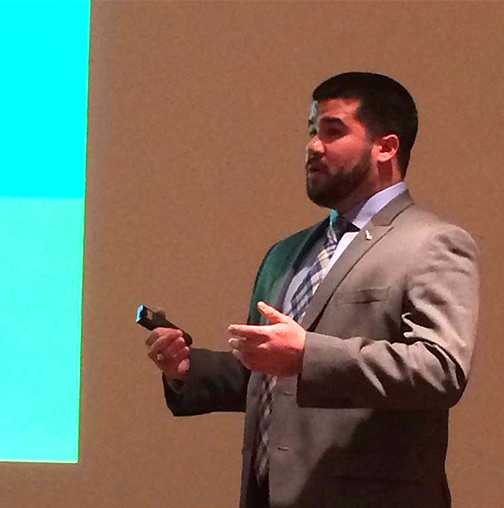
Arthur Leal presents at the Southern Association of Agricultural Scientists conference.

I had the opportunity to present at the Southern Association of Agricultural Scientists (SAAS) conference this semester about a month after I started as lead lecturer for Research and Business Writing, an undergraduate course at the University of Florida.

I imagined my teaching experience helping me in better preparing to present at SAAS. My teaching experience did help me even though the audiences were quite different.

Presenting in front of undergraduate students is quite different than presenting in front of colleagues and faculty members. Nonetheless, I still managed to extend my classroom experience into my presentation at my conference and learn how the two overlapped.

To set the stage for my conference presentation, imagine an auditorium that seats about 100 people. The auditorium was a formal setting with a horseshoe-shaped arrangement. The lighting was slightly dimmed, and there was a podium and projector available for the presenter. There were approximately 30 plus individuals present for the presentation: faculty, staff, professionals and graduate students.

Continue reading

Strategies for promoting cultural diversity in college classes

by Linwan Wu
Ph.D. student, University of Florida

Linwan Wu

Linwan Wu

Cultural diversity in classroom involves two important aspects: one is to help international students adapt to American cultures, and the other one is to encourage all students to respect cultural diversity.

International students’ cultural-related problems:
(1) Social customs
(2) Language problems
(3) Culture shock

How to help international students in your courses:
(1) Help international students understand “culture is relative.”
(2) Encourage them to be open-minded.
(3) Ask them to use their communication skills.
(4) Encourage them to ask questions.
(5) Help them to find a cultural ally.

Continue reading

Strategies for creating multiple-choice test questions

by Julie Dodd

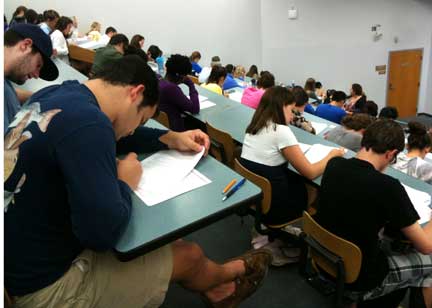
students taking exam in auditorium

I took this photo from the back of the auditorium, while my 130 students were taking an exam. Photo by Julie Dodd

Which of the following is correct about multiple-choice testing?
(A) Multiple-choice questions are easier to write than essay questions.
(B) If you don’t like multiple-choice tests, you won’t ever have to use them as a teacher.
(C) Multiple-choice tests can measure all student learning objectives.
(D) Students like talking multiple-choice tests better than writing essays.
(E) All of the above.
(F) None of the above.

Those were some of the issues we discussed in Mass Communication Teaching, as we talked about student assessment and multiple-choice testing.

Continue reading