University of Florida Graduate Student Teaching Award winners

Congratulations to the 20 graduate students selected as the University of Florida Graduate Student Teaching Award winnners for 2019-2020.

The graduate students were nominated by their departments and were evaluated by the Graduate Student Teaching Awards Committee.

Each student submitted a teaching portfolio, including teaching philosophy and teaching evaluations, and was observed by two members of the committee.

2019-2020 Winners

  • Akieba Allen – Theatre and Dance
  • Richard Brust – History
  • Tara Mercurio Counts – Family, Youth and Community Sciences
  • Lisa Emerson – Microbiology and Cell Science
  • Kaitlyn Erhardt – Psychology
  • Melissa Fenton – Family, Youth and Community Sciences
  • Scarlett Godinez – Chemistry
  • Ethan Kutlu – Linguistics
  • Joana Guerrero-Rodriguez – Spanish & Portuguese Studies
  • Keifer MacDonald – Theatre and Dance
  • Alicia McGrew – Natural Resources and Environment
  • Victoria McNeil – Psychology
  • Caroline Parks – Geography
  • Anthony Pastore – Chemistry
  • Moinul Rahat – Physics
  • Gerald Robinson – Applied Physiology and Kinesiology
  • John Streese – Mathematics
  • Ashley Watts – Mathematics

The top two graduate students received the Calvin A. VanderWerf Award:

  • Dina Benbrahim – Art and Art History
  • Kendall Craig – Chemistry

Continue reading

Students who are tardy to class — What can you do?

If you’re a classroom instructor, you know that students who are tardy to class create a problem for you, their classmates and themselves.

Students who are late to class can become a distraction to you and their classmates, making noise in getting seated or letting the classroom door close loudly or making noise in getting seated.

The tardy students will have missed announcements or directions by being late and then may ask you or their classmates to explain what they have missed.

If a quiz or assignment is underway, the tardy students may ask for additional time to make up for the time they missed by being late.

What can you as a teacher do about students who are tardy to class, especially those students who are frequently tardy to class?

Continue reading

Advice for new teachers for teaching success from UF’s orientation for teaching assistants

UF TA orientation - photo by Daniel Brotherton

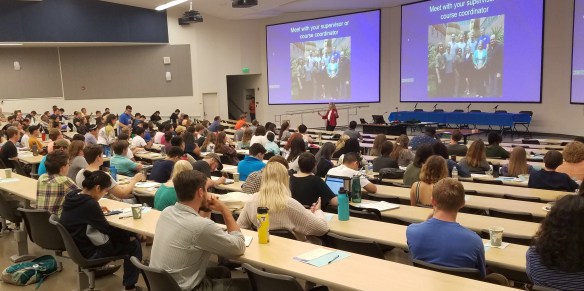
Presenting in Carlton Auditorium is a challenge due to its size. My teaching strategies included moving out from behind the lectern, using easy-to-read slides, and getting the TAs involved. Photo by Daniel Brotherton

More than 400 new teaching assistants attended the University of Florida’s TA Orientation as they prepared to start their teaching assignments next week.

I was honored to be one of the presenters for the half-day program. My topic was Preparing for the First Week of Class, and I had 45 minutes to cover a lot of ground.

Here are some highlights of my advice to the TAs:

Get ready for the start of class

  • Meet with your course supervisor to determine your teaching duties, learn how you’ll be evaluated, obtain the course materials, and learn about the course and the students.
  • Find your classroom and try out the video projection unit and the chalkboard or whiteboard (to make sure you are writing large enough for it to be read by students sitting in the back of the class).
  • Plan your schedule with the courses you’ll take, the courses you’ll be teaching, your office hours, your meetings and deadlines…and remembering to include time for fitness activities, meals and sleep.
  • Review your online persona/avatar and make any needed adjustments to Facebook, Twitter, Instagram, dating apps, etc.

Continue reading

UF Orientation for Graduate Student Teachers, Aug. 13

College students working with partners in auditorium

In my session, I’ll include a Think-Pair-Share activity to demonstrate how active learning can be incorporated into class, even in large auditoriums. This is a photo from last year’s orientation. Photo by Ashleigh Kathryn

More than 400 new teaching assistants at the University of Florida will be attending the Orientation for Graduate Teaching Assistants on Aug. 13.

I’m honored to be one of the faculty on the program. The orientation always is an upbeat and exciting time as we help the teaching assistants begin their teaching at UF.

The half-day orientation includes presentations by veteran faculty and a panel discussion of outstanding teaching assistants and faculty who coordinate TAs.

Continue reading

Professional development for graduate teaching assistants

Falcon Restrepo-Ramos and EUS/SPN 4930 students

Falcon Restrepo-Ramos (front row in Gator blue shirt) with his students at the Student Symposium of Language policies in the multilingual European landscape (EUS/SPN 4930), Spring 2019.

by Falcon Restrepo-Ramos
Hispanic Linguistics, Ph.D. Candidate
Department of Spanish and Portuguese Studies
University of Florida

Years in grad school might seem like a tremendous endeavor for anyone pursuing a graduate degree. Such experience entails years of courses, research, coffee, and, in my case and many others, teaching.

Precisely, the figure of graduate teaching assistant (GTA) in one of the biggest state universities in the country (Go Gators!) not only carries a great deal of work but also memorable moments and many opportunities for innovative teaching and professional development.

Aside from the many different responsibilities of GTAs, which at times feels overwhelming, there are also grants, awards, programs and funding support that can make the University of Florida GTA experience professionally rewarding.

Here I would like to list two main lines of teaching and professional development that helped me maximize my GTA experience at UF. As you will see below, this list follows incremental steps towards a set of goals.

Continue reading

Effective teaching strategies demonstrated by top graduate student teachers

by Julie Dodd

Falcon Restrepo-Ramos receives the Calvin A. VanderWerf Award from Dean of the Graduate School Henry Frierson and Dr. Constance Shehan, chair of the selection committee. The VanderWerf Award is given to the top of the teaching award winners. Morgan Yacoe also received the VanderWerf Award. Photo by Julie Dodd

Promoting student involvement.

Connecting learning to important issues.

Assigning meaningful projects.

Establishing a supportive learning climate.

These were some of the effective teaching strategies employed by the graduate students who were selected to receive the University of Florida’s Graduate Student Teacher Awards for 2019.

As a member of the faculty committee that observes the graduate students nominated for this award, I could feel the energy of those really engaging instructors when I visited their classes. I admired the graduate students’ course design and class planning to create such good learning experiences for their students.

Structuring class activities to get students involved

In the classes I observed that were taught by award-winning graduate students, their students were actively involved. Here are three examples I observed.

The winners of the University of Florida’s Graduate Student Teaching Awards for 2019 and members of the selection committee. Photo by Eric Zamora

In a physiology lab, the students worked in teams to review the results of the physiology lab they had conducted independently online.

Talking with classmates in a small group helped them answer some of their own questions about the lab and prepared them to share their experiences and the questions they still had with the class. In addition, after talking in small groups, the students were more confident in speaking in class.

Continue reading

Changing your course syllabus as you are teaching the course

by Julie Dodd

How much can I change the syllabus while the course is underway?

That’s a question that I’ve been asked when I lead workshops for teaching assistants and new faculty.

uf-syllabi-websiteEspecially when you are teaching a course for the first time, it’s difficult to know if you are creating the right course design.

  • Do the students have the academic background that you thought they would?
  • Have you allocated enough time for major assignments and projects?
  • Did you include enough time in class for you to present the key concepts and to provide time for students to engage in active learning activities?

You get weeks (or maybe just a few class sessions) into the course and realize that you would like to change the syllabus.

I’m a big advocate of syllabus assessment and redesign. However, I’d strongly recommend that during the term you are teaching the course, you should give careful consideration before making any significant changes to the course, such as eliminating a major assignment or test or adding an additional unit or project.

Continue reading

Teaching advice: Syllabus design and strategies for starting the school year

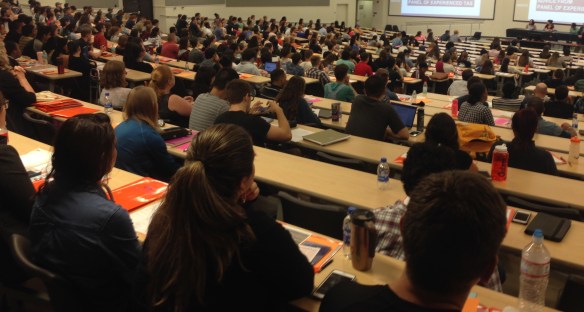
A view from the back of Carlton Auditorium during the orientation for UF’s new teaching assistants.

by Julie Dodd

Julie Dodd at UF TA orientation

In small classrooms or large auditoriums, I like to include ways for students to be active participants in class. Photo by Ashleigh Kathryn

“A Positive Start to Your Teaching: Your Syllabus and the First Week of Classes.”

That was my topic for the the Orientation for Graduate Teaching Assistants at the University of Florida.

More than 400 new TAs spent the day at the orientation that was designed to help them be better prepared to take on their new teaching duties when classes start next week.

Continue reading

Attending new teacher orientation — maximizing your experience

by Julie Dodd

UF TA Handbook 2018-2019

That auditorium looks like C130 in UF’s Chemistry Lab Building — one of the 17 auditoriums I’ve taught in as a UF faculty member.

Thousands of teaching assistants across the country are getting ready to start a new academic year. [More than 136,000 teaching assistants were employed in the most recent count by the Bureau of Labor Statistics.]

Many of those teaching assistants are new and will be attending orientation sessions as part of their preparation.

For more than a dozen years, I’ve been a presenter at the University of Florida’s orientation for new teaching assistants, sponsored by the Graduate School and the Teacher Center. I really enjoy helping the more than 400 new TAs each year be better prepared for success in their teaching.

Here are five suggestions for how to maximize your experience as you attend a new teacher orientation. 

#1 – Consider the questions you have about teaching in general and your teaching assignment.

You’ll be more engaged in the sessions if you consider those sessions as a way of answering questions you have about teaching. So before going to the orientation, make a list of questions you have…and then add to your list as other questions occur to you as you participate in the orientation.

Continue reading

End-of-term debriefing on big-picture learning

by Julie Dodd

students taking exam in auditorium

At the end of the term, teachers (and students) can get caught up in rush of final assessments and grades. That’s important for officially completing the course, however, we can end the term thinking of the details of the course rather than the big-picture learning experience of our course.

Taking time in one of the last classes of the term for a reflection activity can help both us as teachers and our students have more of a sense of closure and accomplishment.

Continue reading