Advice for new teaching assistants — My presentation to TAs at the University of Florida

by Julie Dodd

Gator clockThe clock is ticking as we approach the start of the academic year at the University of Florida and at colleges and universities across the country.

Today, I made a presentation about teaching at UF’s orientation for the more than 400 new teaching assistants that will be teaching labs, classes, and discussion groups this year.

My topic was “A Positive Start to Your Teaching: Your First Week of Class and Your Syllabus.”

Continue reading

First class meeting: Setting personal goals for course; considering issues in higher ed

by Julie Dodd

The structure of school in most parts of the world provides the energizing opportunity of stopping, rethinking and restarting. In higher education, most colleges and universities are on either the semester or quarter system with students and teachers getting a new start at least two or three times a year.

Each of those new starts follows at least a week break. Some of the value of a break is actually taking a break from school tasks. However, the break also provides a time for reading, reflection and revising of course plans.

Tweet about Kent FuchsAs I begin a new semester of teaching Mass Communication Teaching (MMC6930), I am considering the blend of the ongoing issues of teaching and learning (i.e., motivation, critical thinking) and the issues of this moment in time that affect teaching.

In our first class meeting, the class and I will talk about their goals for themselves as teachers and what their hopes are for the course. Many of those issues are consistent from semester to semester as graduate students strive to be effective teaching assistants and prepare for the teaching component of a university teaching career.

Continue reading

Planning is key step for effective teaching — advice to new teaching assistants

University of Florida's New Teaching Assistant Orientation

More than 400 University of Florida graduate students attended the New Teaching Assistant Orientation, held in Carleton Auditorium. Photo by Julie Dodd

by Julie Dodd

The more than 400 new teaching assistants at the University of Florida have been busy preparing for the start of school by attending the New Teaching Assistant Orientation. I enjoyed being part of the team of faculty members, administrators and teaching assistants who made presentations for the orientation.

My presentation was “A Positive Start to Your Teaching: Your Syllabus and the First Week of Class.” You can download the PDF handout of the slides (5MB) – dodd_2014_UF_TA_orientation_slides

[You can check the UF Teaching Resources tab at the top of the blog for a list of links to helpful teaching resources, including syllabus policies and the UF Undergraduate Catalog.}

I appreciated everyone participating in the short peer-to-peer discussions on topics related to teaching. Thanks to those of you who asked questions, which included:

  • What activities can you use to learn student names?
  • What are tips for international teaching assistants for whom English is not their first language?
  • What advice do you have for how to avoid discipline problems that can be caused by cellphones?

Preparing for the presentation is always helpful for me, as talking about planning for teaching success helps me in my own class planning.

Thanks to Drs. Paul Duncan, Winifred Cooke and Rhonda Moraca for coordinating such a helpful program. For more information on support for teaching assistants (including the “Teaching at the University of Florida” handbook), check the UF Teaching Center.

Creating online teaching portfolio helps you demonstrate teaching and technology abilities

portfolio_chrisby Julie Dodd

Having an online teaching portfolio is helpful for anyone interested in seeking a job in teaching.

  • You can include the link — in correspondence you send about job applications, in your email signature, with your LinkedIn profile, on your business card, on your print curriculum vitae or résumé.
  • People can find you even if they aren’t looking for you specifically. Materials that you have included in your online portfolio can be found in online searches (such as the topic for a syllabus you’ve posted). And in finding contents of your portfolio, you have been discovered.

Continue reading

8 steps for developing a syllabus

syllabus_start_wby Julie Dodd

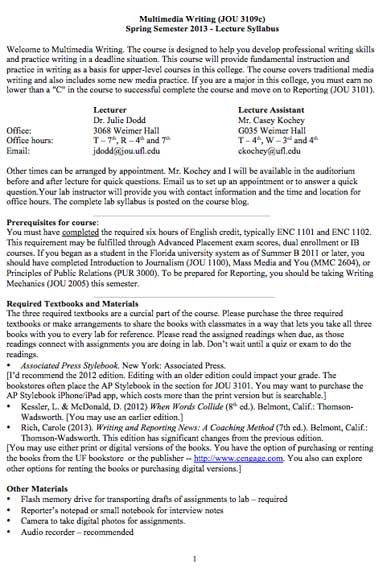
The major assignment for Mass Communication Teaching is for you to develop a syllabus for an undergraduate communications course and create course materials, including an exam or major project and lesson plans.

The process for developing this syllabus will help you prepare for all the syllabi that you will be developing if you go into teaching.

1. Determine the schedule for your class.
You are designing a three-credit course. Will it meet for three hours once a week, one hour three times a week, or meet for two hours one day and one hour another day?

Continue reading

Develop proposal for undergraduate course you want to develop

New teaching assistants and new faculty members often start learning about the values of and problems of a syllabus when they are handed a syllabus and told, “Here’s what you’ll be teaching.”

Sometimes that’s literal — As a teaching assistant, you are given a syllabus and that’s what you are to follow. Having the syllabus already prepared can save you from making literally dozens of decisions about the course.

Sometimes you are given the syllabus to serve as a foundation for the syllabus that you will be developing for the course.
You want to be able to develop your own syllabus — recognizing how your course fits into the curriculum and bringing your own strengths to the course.

As part of your teaching portfolio, you are developing course materials for an undergraduate communications course — the syllabus, an assessment activity and evaluation criteria, and two lesson plans.

You’ve already been thinking about what course you’d like to develop. What you need to do for class for Sept. 17 is to develop a written proposal for your course. Here’s a Word document that provides a structure for your proposal — mmc6930_course_proposal
Download the form, type in the needed information, and bring the printed proposal to class on Sept. 17.

Once you have the course determined and the proposal written, you can begin thinking about planning your syllabus:

  • Identify syllabi online for similar courses.
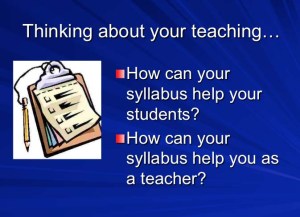
  • Answer the questions (above — in image) about how a syllabus can help your students and help you.
  • Check the links I’ve provided on the blog (UF resources) for information that you will include in your syllabus.
  • Read the chapter in McKeachie’s Teaching Tips about developing a syllabus.
  • Read a post I wrote about creating a syllabus.
  • Develop a list of questions you have about creating a syllabus.

Use first-class activities to get to know your students and their goals

Before class met yesterday, the 14 students in Mass Communication Teaching were names on a roster. I knew only one of them.

By the end of class, not only did I have a face to go with every name but I knew some important information about each student, including his/her previous teaching and work experience and educational background. Getting to know the class members can be accomplished by having students fill out an information sheet (paper or digital) or by having student share information in class introductions. As this is a small class, we could have the individual sharing.

In a small-group activity, each group was asked to develop a list of key issues related to teaching in higher education. The four teams’ lists are pictured above. We used the lists to begin our semester-long discussion about teaching issues, from motivating students to being fair in grading to figuring out how to use technology effectively.

This small group activity accomplished several objectives:

  • The students had the opportunity to get to know the other members of their group. Most of the students are in their first semester of graduate school, so they didn’t know each other.
  • The activity helped provide variety in a three-hour class time block.
  • Everyone had the opportunity to share ideas. Even though a class of 14 is a small class, time would not have allowed everyone to have had the opportunity to talk if we had stayed as a large group.
  • I was able to see what some of their concerns are as teachers and can address those issues during the semester.

Getting ready for a new school year to start at the University of Florida

The University of Florida Orientation for New Graduate Teaching Assistants takes place in the Reitz Union Grand Ballroom. Here’s the iPhone panorama I shot from the back of the auditorium before I made my presentation at the 2011 orientation.

I know a new school year is about to start when it’s time to work on the presentation that I’ll be making as part of the University of Florida’s Orientation for New Graduate Teaching Assistants.

Dr. Ken Gerhardt, Associate Dean of Academic Affairs in the Graduate School, and Dr. Winifred Cooke, Teaching Center Director in the College of Liberal Arts and Sciences, coordinate the program, and have invited me to be one of the presenters.

I’m delighted to be part of the program. My topic is “Your Syllabus and the First Week of Class.” As part of being a presenter, each of us is asked to develop a handout to be part of the packet of information the teaching assistants receive. I wanted to be able to include the URL to this teaching blog, so I’m launching the blog today.

You can see from the number of grad students in the photo that UF counts on teaching assistants to be an important part of university instruction. This was the group who attended the orientation last year. Typically UF has about 350 to 400 new teaching assistants each year. I’m glad to help them have a good start to their UF teaching.