
Grading rubric provides clarity for instructors and students

by Greenberry “Tripp” Taylor
Master’s student, University of Florida

Greenberry "Tripp" Taylor

Tripp Taylor’s teaching assistantship is working with undergraduates in the Innovation News Center.

Having a checklist usually makes things simpler and more efficient. For example, if you go to the grocery store with a list, chances are you can make it in-and-out quickly because you know exactly what you’re looking for.

This is a good way to think of a rubric – a very advanced, evaluative checklist used by instructors. Just like a grocery list, instructors can take time and think about what objectives they want an assignment to have. Having set expectations can help eliminate subjectivity, and also shave some time off the grading process.

Continue reading

3 strategies for promoting discussion in college classes

by Huishan Wang
Master’s student, University of Florida

When I taught class in Mass Communication Teaching, we talked about the experience we’ve had with class discussions, the relationship between discussion and active learning, and the advantages and disadvantages of discussion.

To demonstrate one discussion strategy, I used an activity — the Fishbowl — to discuss more about the discussion teaching strategy.

Use Fishbowl strategy as way to encourage discussion

The class was divided into two groups. Three of the class were with me in the inner circle (the Fishbowl), and the others were in the outer circle. The inner circle participated in the discussion that I led, while the class members in the outer circle took notes based on the discussion, which included noting the discussion’s content, any problems or things are interesting to them, or any comment on this Fishbowl activity.

Continue reading

7 tips for writing cover letters for faculty jobs

by Julie Dodd

Your letter of application (or cover letter) is a key part of the faculty job application process. The cover letter is how you introduce yourself to the search chair and the search committee. The letter should convey your interest (and enthusiasm) for the position and provide an overview of you, referring to your vitae and online portfolio where more information is provided.

Here are some general tips for writing a cover letter.

Tip #1 – Be sure to use the format for a business letter.

Because most of our communication is now done with email and social media, writing business letters is a new format for many who are applying for jobs. You can find many examples online. The Purdue OWL (Online Writing Lab) provides tips for academic cover letters and a sample letter.

Continue reading

5 ways teaching helped me be more effective in making a conference presentation

Arthur Leal
Ph.D. student, University of Florida

Arthur Leal

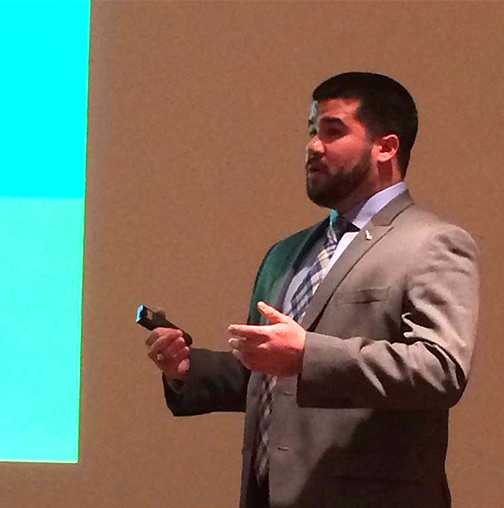
Arthur Leal presents at the Southern Association of Agricultural Scientists conference.

I had the opportunity to present at the Southern Association of Agricultural Scientists (SAAS) conference this semester about a month after I started as lead lecturer for Research and Business Writing, an undergraduate course at the University of Florida.

I imagined my teaching experience helping me in better preparing to present at SAAS. My teaching experience did help me even though the audiences were quite different.

Presenting in front of undergraduate students is quite different than presenting in front of colleagues and faculty members. Nonetheless, I still managed to extend my classroom experience into my presentation at my conference and learn how the two overlapped.

To set the stage for my conference presentation, imagine an auditorium that seats about 100 people. The auditorium was a formal setting with a horseshoe-shaped arrangement. The lighting was slightly dimmed, and there was a podium and projector available for the presenter. There were approximately 30 plus individuals present for the presentation: faculty, staff, professionals and graduate students.

Continue reading

Strategies for promoting cultural diversity in college classes

by Linwan Wu
Ph.D. student, University of Florida

Linwan Wu

Linwan Wu

Cultural diversity in classroom involves two important aspects: one is to help international students adapt to American cultures, and the other one is to encourage all students to respect cultural diversity.

International students’ cultural-related problems:
(1) Social customs
(2) Language problems
(3) Culture shock

How to help international students in your courses:
(1) Help international students understand “culture is relative.”
(2) Encourage them to be open-minded.
(3) Ask them to use their communication skills.
(4) Encourage them to ask questions.
(5) Help them to find a cultural ally.

Continue reading

Strategies for creating multiple-choice test questions

by Julie Dodd

students taking exam in auditorium

I took this photo from the back of the auditorium, while my 130 students were taking an exam. Photo by Julie Dodd

Which of the following is correct about multiple-choice testing?
(A) Multiple-choice questions are easier to write than essay questions.
(B) If you don’t like multiple-choice tests, you won’t ever have to use them as a teacher.
(C) Multiple-choice tests can measure all student learning objectives.
(D) Students like talking multiple-choice tests better than writing essays.
(E) All of the above.
(F) None of the above.

Those were some of the issues we discussed in Mass Communication Teaching, as we talked about student assessment and multiple-choice testing.

Continue reading

Tips and checklist for creating college course syllabus

by Julie Dodd

checklist of developing course syllabusWe spent much of our last class meeting discussing the many decisions involved in creating an undergraduate course syllabus.

We talked about how Bloom’s Taxonomy (1956), updated by by Anderson and Krathwohl (2001), can help with one of the most important first steps in developing a course — determining the student learning outcomes (SLOs) for the course.

Developing specific and measurable SLOs can be aided by using action verbs to operationalize each SLO — http://uwf.edu/cutla/slo/actionwords.pdf

Continue reading

Reading faculty job announcements and developing your curriculum vitae can help you prepare for the faculty job market — even if you won’t be applying for jobs for several semesters

by Julie Dodd

A good way to be prepared for the faculty job market when you graduate is to begin analyzing the job market and preparing your professional materials several semesters before you graduate.

How can you do that?

Create your curriculum vitae
Most graduate students have a résumé. The résumé typically includes education, work experience, specialized skills, and relevant awards and activities. The typical résumé is one page. Often getting the résumé to fit on one page is a combined effort of editing and page design.

The curriculum vitae — rather than being very condensed — is a more detailed listing of your professional life. In most CVs, the sections are: education, teaching, research (which can include research presentations, publications and grants), service, awards, and specialized skills.

Continue reading

Prepare for discussion of curriculum development with readings and writing proposal for a course you’d like to develop

by Julie Dodd

Curriculum development is an important part of a faculty member’s work. Curriculum development can mean creating a brand new course, updating and revising an already existing course, or creating lesson plans, class plans or assignments and grading criteria.

We’ll talk about both the big picture of curriculum development and the specifics next week in class.

To prepare for Monday’s class (Jan. 13):

  1. Identify an undergraduate communications course that you’d like to develop. You can select a course that is offered in our college or that is offered in another communications program, or you can develop a new course.
  2. Use the template that I’ve provided to develop a proposal for the course. Bring the printed proposal to class next week. mmc6930_course_proposal_template
    Continue reading

Brainstorming activity helps us develop agreed-upon list of topics to challenge us during semester

by Julie Dodd

In starting the semester for a class like Mass Communication Teaching, hearing from you (the students in the course) about topics you are interested in covering is a good way to match what my plans for the semester are with what you hope you will be learning about.

From brainstorming with a partner, here are some of the topics the you said you hoped we’d discuss:

  • Fairness in grading
  • Motivating students to complete outside-of-class activities, like reading the course syllabus and reviewing rubrics.
  • Technology use in class — and keeping technology from being a distraction
  • Establishing guidelines to promote appropriate conduct in class, especially in group discussion

Continue reading