4 tips for designing a successful group project

by Seul Lee
PhD student, University of Florida

Group projects are important for students majoring in advertising, public relations, journalism and telecommunication because those industries require a higher level of cooperation.  If structured well, group projects can promote important intellectual and social skills and can help students prepare for work world in advance.

Group projects are distinguished from group activities in that group projects are more likely to be long-term-based and require group product(s), such as a written report, a presentation, a design work, or a paper.

Positive group experiences contribute to develop skills specific to collaborative efforts and to have a field experience with real-world clients. However, there are often typical problematic group members, such as a free rider, a dictator, the do-it-all, the procrastinator, the socializer, the academically poor student, the quiet student, and/or the complainer.

Continue reading

Advice for preventing plagiarism and cheating in the college classroom

by Arlena Jackson
PhD student, University of Florida

Prevention is the best solution to mitigating plagiarism and cheating in the class room. When prevention is the priority, the teacher commits to investing the time that is needed to help students understand their assignments and the resources available to students to assist them with writing and to provide tutoring as needed.

Creating a classroom culture that promotes academic honesty can be fosters by the class syllabus. The syllabus can serve as a written document that guides the class format and assignments from start to finish, enabling students to plan the time needed to complete assignments and requiring them to turn in big projects in stages to prevent them from trying to complete too much work at the last minute. The syllabus is a great tool to remind  students to their university academic honor code and code of conduct.

To learn more about preventative measures that are available to teachers, please visit this site, which is sponsored by the University of Florida’s Warrington School of Business:

http://warrington.ufl.edu/itsp/docs/instructor/OnlineAssessment.pdf

Here you’ll find recommended teaching activities for preventing cheating and plagiarism. My favorite is the 21 tips for handling technology advanced cheating.

As a teacher, be sure to check to see what resources your university provides to assist you in determining plagiarism in student writing. For example, the University of Florida provides Turnitin.

Remember, you are not alone. Familiarize yourself with the department at your university who is responsible for managing academic dishonesty violations. At the University of Florida, the Dean of Students Office manages this process and should be contacted when assistance is needed to manage academic dishonesty or code of conduct violations.

Arlena Jackson is a student in Mass Communication Teaching.

6 tips for promoting cultural diversity in the classroom

by Alexa Lopez
English Education graduate student, University of Florida

The United States is becoming more diverse – and so are our classrooms.

As future teachers, we must make sure that our classrooms are inclusive environments where cultures are respected and celebrated. By doing this, we will not only motivate our diverse students and help them better adjust to the American culture, but we will also be helping all our students become well-rounded global citizens.

Also, remember that multicultural students will not be the only ones in your classroom experiencing stressors related to diversity that will affect them academically. All students come from unique backgrounds and, as a result, have varied expectations of the college classroom that are grounded in their communities, families and previous academic experiences.

Continue reading

Using technology to promote student-centered learning

by Hasani McIntosh
PhD student, University of Florida

Technology is found everywhere, touching almost every part of our lives, our communities, and our homes.  But many teachers are still hesitant to allow it onto their classrooms.  Never the less, classrooms have come a long way and growth will only continue.  There’s a unique feel when walking into a modern workplace like Google or Apple. Students should do their best to immolate work environments.

Incorporating technology into the classroom is important for adapting to modern times.  As teachers we have a responsibility to prepare students for the real world. The professional realm is saturated with all kinds of innovations.  Computers can no longer be restricted to computer labs.  For example, accepting papers electronically is now common practice.

The Web connects students to experts in the real world and provides numerous opportunities for expressing understanding through images, sound, and text. New tech tools for visualizing and modeling, especially in the sciences, offer students ways to experiment and observe phenomenon and to view results in graphic ways that aid understanding. And, as an added benefit, with technology tools and a project-learning approach, students are more likely to stay engaged and on task, reducing behavioral problems in the classroom.

Technology isn’t the Golden Fleece.  The use of technology won’t make you the best instructor.  Effective instructors are likely to use technology effectively; ineffective instructors are likely to use technology ineffectively.  Technology should supplement instruction.  Technology is a stimulus, not the end to all quests for knowledge.  Education MUST have a learner-centered approach.

Integrating technology into classroom instruction means more than teaching basic computer skills and software programs in a separate computer class. Effective technology integration must happen across the curriculum with the intention of supporting lesson plans.

Resources:

Svinicki and McKeachie — Some researchers report that although many public schools have access to the Internet, some students may be less experienced with using the Internet because their homes can’t afford it. Therefore, an instructor might want to have each student fill out a survey designed to gather information about each.

Hasani McIntosh is a student in Mass Communication Teaching

Using discussion helps promote student learning

by Carina Seagrave
UF master’s student

My presentation topic was Using Discussion in the Classroom.  Some important information which should have been taken from my presentation is listed below:

  • Discussion helps students internalize lessons
  • Discussion gives teacher another method for testing their students
  • Discussion helps us form arguments, articulate positions and learn from others
  • The Socratic Method is when a teacher argues against a student’s point of view to get them to see another
  • Information Retrieval helps teacher’s test student knowledge but isn’t a discussion technique

In addition to what I shared in my teaching presentation,  I wanted to include a few other points.

The first is to divide class time into lecture, discussion, group work, and visual aids. The average attention span of a human being is about 45 minutes so teachers should always keep that in mind when teaching.

The second is that teachers should always reword what students say during discussion so that (A) students who didn’t hear it can get it a second time and (B) to clarify information before speaking further on it.

An important resource to my presentation and a great resource for new teachers was the “Penn State Teacher II.”  This handbook was written for new teachers at the university level and is a compilation of helpful articles written by scholars on teaching.

Carina Seagrave is a student in Mass Communication Teaching.

Tips for dealing with problem students and student problems

by Mariana De Maio
PhD student, University of Florida

There isn’t a teacher who hasn’t had to deal with student problems and problem students. Sooner or later you will have to deal with a student who has a problem or a student who is disrupting your teaching, so it’s better to be prepared. There are three common problems that higher education teachers face:

Students with academic problems

Some students may be aggressive or may challenge the materials presented in class. This is a good opportunity to delve further into the subject matter and to teach the student how to approach the subject in a critical fashion.

Some students seek the “truth” because they see the world divided into true and false statements. This is a good opportunity to guide these students into the complex pathways of the subject matter, arriving at various conjectures and competing hypotheses and presenting a set of ideas upon which the profession may agree.

Continue reading

The why and how of making accommodations for students with disabilities

by Kevin Hull
PhD student, University of Florida

While there are a multitude of different skills a new instructor must learn when entering the classroom, there may be none more important than dealing with students with disabilities.  If not addressed correctly, both the teacher and the institution could face some heavy penalties from the government.

Simply put, teachers need to know the correct way to accommodate students with disabilities because it is the law.  A law passed in 1973 states:

No “otherwise qualified” individuals, solely by reason of their disabilities can “be denied the benefits of, be excluded from participation in, or be subjected to discrimination” in (secondary institutions).

The main point of this law is that students with disabilities need to have the same opportunities to succeed as others in the classroom.

This should be achieved through inclusion.  Students with disabilities should not be singled out, and instead should be treated as equals to their classmates.  Instructors will be provided with a listing of the accommodations that must be followed for the individual student.  The instructor should meet with the student so they can come to a determination together about what will work best for the semester.

Here at the University of Florida, the Disability Resource Center is available to help answer many questions to ease concerns.  Their website is: http://www.dso.ufl.edu/drc/

The DRC can help with testing accommodations, supplying note-takers, and creating a positive working experience between the student and the faculty.  Please check with them if you have any questions or concerns regarding a student with a disability in your classroom.

Kevin Hull is a student in Mass Communication Teaching.

The power of classroom delivery for promoting student learning

by Kortni Alston, MBA
PhD student, University of Florida
Graduate Teaching Assistant

The desks are narrowly placed though out the classroom, students are starting to arrive, and the teacher is waiting for the audio-visual equipment to warm up.  It sounds like a typical day in any classroom across the country, but there is one factor that differentiates some of the classrooms: the best teachers stand out simply with classroom performance or delivery.  How a teacher performs in the classroom can enable student engagement and ignite passion in a fairly listless subject matter.   Extraordinary teachers understand the value of bringing a lesson to life and using themselves as a conduit to share knowledge and experiences.

Ron Clark has proven that you don’t have to be a college professor to inspire educators.  Clark is the co-founder of the Ron Clark Academy (RCA), the non-profit middle school in Atlanta, Georgia that serves as a training ground for teachers. Clark and Kim Bearden, the co-founder and executive director of RCA are educating teachers from around the world more than 13,000 from all levels of education make the pilgrimage to their training facility to learn best practices from Clark, Bearden, and their team.  Their approach exemplifies passion in the classroom that values student engagement.  To see the school in action visit:

https://www.youtube.com/watch?v=kFSR53NJFAY&list=UUFEx_RwX7lLrwUib0VtfINQ&index=15&feature=plcp

Continue reading

Being aware of your own learning style preferences as a teacher and your students’ learning style preferences can help you design more effective instruction

by Lauren Bayliss
PhD student, University of Florida

As teachers, we come to the classroom with a lot of preconceived notions regarding what good teaching is.  We have taken classes throughout our lives, and we know what helps us learn.  However, recognizing that what helps one person learn may not help every person learn is important when preparing lesson plans.  Teachers need to recognize both their own natural preferences in the classroom as well as the preferences that been cultivated by the dominant teaching culture.  Both influence teaching preferences, but may not prepare teachers to teach to the majority of students.

Learning styles provide one way to consider these issues.

Before you read on, find out your own learning style to give context:

Learning styles: http://www.personal.psu.edu/bxb11/LSI/LSI.htm

Learning styles can be described in many ways but commonly are broken down to three preferences: auditory, visual, and tactile (also called kinesthetic).

Continue reading

Use WordPress.com to create a teaching portfolio

Jeff Neely developed his website when he took Mass Communication Teaching in 2007.

Creating a teaching portfolio can be helpful as you prepare to enter the job market for a faculty position. Some job postings will ask you to submit a teaching portfolio or materials that would be in a teaching portfolio, such as a syllabus you’ve developed or a teaching philosophy.

A great way to have those materials available for others to review and to demonstrate your own technology skills is to have your teaching portfolio posted online.

As your final project for the course, you are to create an online teaching portfolio, using materials that you have been developing this semester, including your vitae and your undergraduate course materials.

You will be creating the portfolio as a WordPress blog. Advances in WordPress have made it a great choice for developing what used to be termed a website. More organizations are converting from coded websites to WordPress blogs. Our college’s “website” is, in fact, a WordPress blog — http://www.jou.ufl.edu

In Monday’s class, we’ll have workshop to work on your WordPress site. Here’s what you need to do.

Start mapping out what you’d like your online portfolio to include. Make a list and have your materials as digital files. Photos should be optimized for the Web. Slide presentations should be saved as PDF handouts. If you aren’t familiar with how to do that, we’ll review in our workshop.

Set up your WordPress account. Be sure to set up a free WordPress.com account and not a WordPress.org account. Start exploring the site. If you’ve selected a theme, that can help you be better prepared. A theme I think would work well for a portfolio is Twenty Eleven, which is the theme I used for this blog.

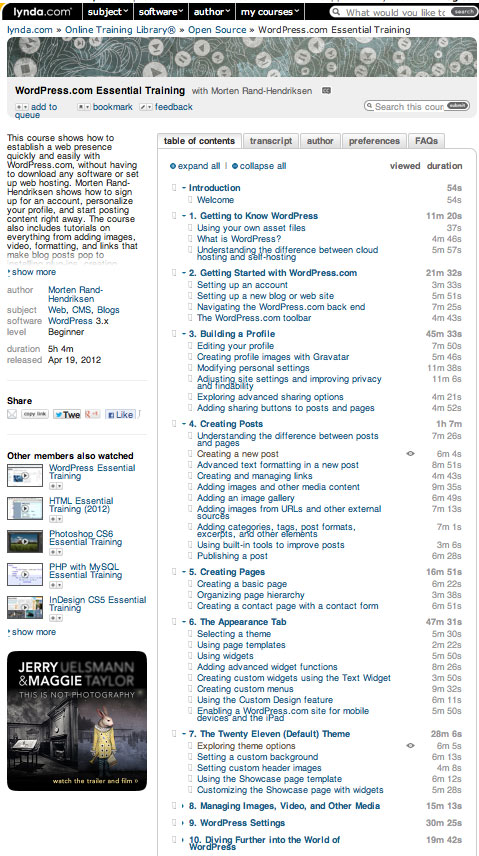
Watch Lynda.com videos to help you learn about using WordPress.com. As a UF student, you have access to hundreds of free Lynda.com videos. This is a great resource. To learn about WordPress, I’d suggest that you watch tutorials in WordPress.com Essential Training by Morten Rand-Hendriksen. (When you go to Lynda.com, click on the B for blogging and then select this training package.) You’ll see that the training is divided into dozens of short videos — similar to the Khan Academy approach to training. You can watch some of these tutorials prior to our Monday workshop and then watch others as you continue to work on your online portfolio. Most are just a few minutes.
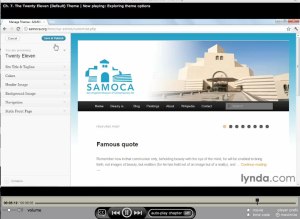
Bring with you to class: Your laptop (be sure it’s charged) and digital files. Those files can include your bio, a headshot (and I’ll bring my camera to take headshots), your vitae, your course syllabus, your slides from your teaching presentation, etc. And I know you’ll bring your I’m-ready-to-learn outlook.

Here are two sample online portfolios from former students in Mass Communication Teaching:
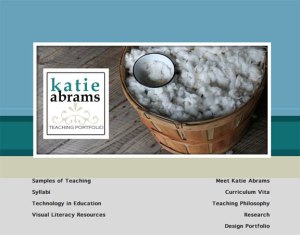
Katie Abrams was a doctoral student in UF’s Ag Communications program. Visit her website to see how she organized materials.

Jeff Neely (website at top of post) developed his website in 2007 when he was a student in Mass Communication Teaching. At that time, we created online portfolios in Dreamweaver. Using WordPress.com makes the whole process much easier!

If you’re interested in learning more about blogging, which could become an asset for your future teaching, you should consider taking Multimedia Blogging (MMC 6930) next semester with Dr. Judy Robinson.

Students in the course develop their own blogs and learn to self-host and incorporate multimedia — including audio and video —  into their blogs.