Developing lesson plans should be based on accomplishing student learning objectives

You can develop a well-thought-out course syllabus but the class-by-class meetings (or the lesson-by-lesson development of an online course) are what is going to determine the effectiveness of the students’ learning experience.

Here’s where the lesson plan comes into play.

The lesson plan lets you map out an approach to meeting the learning outcomes for each class meeting.

Lesson plans can take a number of approaches – from a list of questions to guide the class discussion to PowerPoint slides to present information. But the foundation of the lesson plan should be student learning.

It can be tempting to take the approach of structuring a lesson based on covering the content in a particular chapter or explaining a concept. But the key for you as the teacher is to determine: What is it that the student should be able to do/think/know?

Once you’ve determined that, you want to plan a lesson that makes that learning happen.

So start with the student learning objectives. List those for each class. You may have one to four objectives per class meeting. Fewer if the objective is more complex, more objectives if the concepts are easier.

Once you’ve determined the learning objectives for a particular class meeting, you will develop a plan to make that happen.

Two of my favorite educational leaders who have studied effective instruction are Madeline Hunter and Robert Gagné. Penn State has a useful website on lesson planning that briefly explains each of their approaches to structuring lesson plans.

Gagné’s Events of Instruction
Madeline Hunter’s Seven-Step Lesson Plan

What both of those models provide is a template for structuring a lesson. Both take the approach of:

  • Getting students interested in what is to be learned
  • Reviewing previous learning
  • Presenting the learning
  • Having students practice with new learning
  • Assessing learning
  • Providing students with feedback on their learning

You won’t include all of those components in every lesson. But both Gagné’s and Hunter’s approaches to structuring learning are good reminders of why the approach of teaching for a month before providing students any opportunity to demonstrate what they are learning isn’t as effective a learning approach as providing students with regular and on-going opportunities to demonstrate learning and receive feedback.

Using their models to planning a lesson makes for a much more student-learning-driven approach than just opening up PowerPoint and creating slides (even good slides).

In class, we’ll talk about different approaches to creating lesson plans.

Developing a college course: You’re part of a big picture of curriculum procedures and accrediting standards

When you develop a course syllabus, you are part of a much bigger process that includes your own department’s curriculum, the university’s curriculum guidelines, and accrediting standards.

At the University of Florida, every college is required to develop measureable student learning outcomes (SLOs) and to collect data on every student in the college. This new requirement is due to an upcoming accrediting assessment of UF in 2014 by the Southern Association of Colleges and Schools. Faculty are to use the student results of the assessment of the SLOs to evaluate and improve teaching and learning.

As a college, we also have accrediting standards from the Accrediting Council on Education in Journalism and Mass Communication (ACEJMC), the accrediting component of the Association for Education in Journalism and Mass Communication (AEJMC). Communications programs are evaluated on nine accrediting standards. Standard 2 is Curriculum and Instruction.

Take a quick read though Standard 2 — professional values and competencies and the indicators for assessment — and consider those factors in relation to the course that you would like to teach.

The curriculum of communications programs has become a hot topic of discussion in the last couple of years. Programs are grappling with how to respond to the changes going on in the media industry. Some say that time spent on teaching hardware and software takes away from teaching the fundamentals. Others say that the changes in the media industry have changed what the fundamentals are.

Read An Open Letter to America’s University Presidents that was written by the leaders of six major grant-awarding foundations that have been funders of initiatives in communications and higher education. The letter was published Aug. 3, 2012, and has caused some lively debate.

Also read “Not So Fast,” one of the many responses countering the letter.

Develop proposal for undergraduate course you want to develop

New teaching assistants and new faculty members often start learning about the values of and problems of a syllabus when they are handed a syllabus and told, “Here’s what you’ll be teaching.”

Sometimes that’s literal — As a teaching assistant, you are given a syllabus and that’s what you are to follow. Having the syllabus already prepared can save you from making literally dozens of decisions about the course.

Sometimes you are given the syllabus to serve as a foundation for the syllabus that you will be developing for the course.
You want to be able to develop your own syllabus — recognizing how your course fits into the curriculum and bringing your own strengths to the course.

As part of your teaching portfolio, you are developing course materials for an undergraduate communications course — the syllabus, an assessment activity and evaluation criteria, and two lesson plans.

You’ve already been thinking about what course you’d like to develop. What you need to do for class for Sept. 17 is to develop a written proposal for your course. Here’s a Word document that provides a structure for your proposal — mmc6930_course_proposal
Download the form, type in the needed information, and bring the printed proposal to class on Sept. 17.

Once you have the course determined and the proposal written, you can begin thinking about planning your syllabus:

  • Identify syllabi online for similar courses.
  • Answer the questions (above — in image) about how a syllabus can help your students and help you.
  • Check the links I’ve provided on the blog (UF resources) for information that you will include in your syllabus.
  • Read the chapter in McKeachie’s Teaching Tips about developing a syllabus.
  • Read a post I wrote about creating a syllabus.
  • Develop a list of questions you have about creating a syllabus.

60 Minutes tells story of Kahn Academy and potential impact on teaching and learning

From Kevin Hull

Here is the link to the 60 Minutes story on the Kahn Academy that ran last Sunday.

The link has both the written article, and a link to the video story.  I would recommend watching the video because it is interesting to actually watch Mr Kahn put his videos together.  It was neat to see how kids seem to be responding to the videos and it is forcing teachers to look at the classroom differently.

‘Rebooting the Academy’ — How could innovations impact you teaching in higher education?

I hope that reading “Rebooting the academy: 12 tech innovators who are transforming campuses” is encouraging you to think about some of the traditional approaches of higher education and how some of those approaches could/should be changed.

I’m asking you to write a five-page paper responding to the book as a graduate student who is considering a career teaching in higher education (syllabus, p. 4). You’re writing your response to me but can consider your audience to be both graduate students planning a career in high education and those teaching in higher education. So we have a level of awareness about higher education teaching, learning, policies and politics.

As you read the book, you’ll see that the 12 innovators discuss a wide range of higher education issues. Some of those topics include:

  • Rethinking the traditional 50-minute teaching format to becoming 10-minute video instruction on a specific topic.
  • Making textbooks more affordable by having universities work out purchasing contracts for digital books.
  • Making college more affordable with online courses
  • Incorporating the technology students have (cellphones) into teaching and learning
  • Changing the academic publication cycle

You may want to comment on the book overall or selected articles. Writing in first person is appropriate. Remember that the emphasis is to be on the book itself. Your written response should not become your personal commentary on higher education.

One possible approach for your response paper is to look at the book from the perspective of our conversation in class about goals for the course. Many of the topics raised in our class discussion are addressed by the “Rebooting” innovators. How would their innovations affect you as a graduate teaching assistant and/or a college faculty member?

Here is the list of the topics you identified that you considered important issues for the discussion of teaching and learning:

  • Integrating technology use
  • Promoting professional development
  • Dealing with diversity
  • Teaching differences between lecture and hands-on teaching
  • Teaching compensation
  • Classroom management – Controlling your classroom
  • Pacing of instruction – Realizing that students may be learning at different rates.
  • How flexible should teachers be – responding to student issues
  • Evaluation – Different ways to evaluate student performance
  • Keeping the class current – especially as assigned texts may not be up to date
  • Teaching outside of your specialty
  • How to approach difficult content
  • How to deal with different classroom environments
  • How to develop curriculum
  • How to manage classroom expectations
  • How to grade fairly – and be able to finish on time
  • Engaging students in class
  • Engaging student in critical thinking
  • Bringing technology to the classroom
  • Keeping the classroom fresh
  • Balancing goals of curriculum with student needs and interests

In our next class meeting, each of you will be a one-minuter presenter on one of the “Rebooting” innovators. Your objectives are to provide the class with a reminder of the person and what his/her innovation is and then to pose a question to start a discussion of the implications of the innovation for teaching in higher education.

Use first-class activities to get to know your students and their goals

Before class met yesterday, the 14 students in Mass Communication Teaching were names on a roster. I knew only one of them.

By the end of class, not only did I have a face to go with every name but I knew some important information about each student, including his/her previous teaching and work experience and educational background. Getting to know the class members can be accomplished by having students fill out an information sheet (paper or digital) or by having student share information in class introductions. As this is a small class, we could have the individual sharing.

In a small-group activity, each group was asked to develop a list of key issues related to teaching in higher education. The four teams’ lists are pictured above. We used the lists to begin our semester-long discussion about teaching issues, from motivating students to being fair in grading to figuring out how to use technology effectively.

This small group activity accomplished several objectives:

  • The students had the opportunity to get to know the other members of their group. Most of the students are in their first semester of graduate school, so they didn’t know each other.
  • The activity helped provide variety in a three-hour class time block.
  • Everyone had the opportunity to share ideas. Even though a class of 14 is a small class, time would not have allowed everyone to have had the opportunity to talk if we had stayed as a large group.
  • I was able to see what some of their concerns are as teachers and can address those issues during the semester.

What skills should our students have to enter the media field?

The six media professionals were asked what qualities they think our students should have.

Grammar and spelling ability – So many aspects of media work involve writing, including writing pitches. A proposal for a $10,000 project could be a good concept but could lose funding due to errors in writing.

Curiosity – Curiosity about people and what makes people tick. Curiosity about issues.

Being able to realize and understand cultural context.

Passion about the media industry.

What should journalism educators do to respond to changes and challenges in the industry?

Jon Morris was the moderator, using an iPad as a microphone. Three of our guests were in the CMIR and three were brought in with Google Hangouts.

How should journalism education respond?

Brancaccio – People browse the Internet for headlines. We have to come up with ways to draw people into the more in-depth news. Provide meaning and context. We need to be able to use different platforms but also need to determine where the serious journalism will happen.

Cohen – So much of it is developing content. Can you tell a story so that it fits the distribution outlets you’re working in? Universities need to have more ties with media professionals and media organizations. He is going to be working with Sylvia Chan-Olmstead on 2015 project, a study of students who entered UF in 2011.

Williams – It’s not about technology. It’s about understanding brands and brand strategy. Use that knowledge to make a difference to the client’s business. Important for students to understand what’s going on in the industry.

Finberg – Technology is important but it can’t be just about technology. Students need the critical skills involved in good storytelling — using deconstruction or writing good stories. Get media literacy into the college curriculum. If students understand the messenger, they’ll better understand the message. What is that college journalism educators do best and what partnerships could be developed to address those issues that can’t be done as well locally grown.

Seaman – Pop culture doesn’t go away in our industry. Doesn’t have to be a dumbing down of popular culture but explaining how a media product is created and the rationale behind the decisions. Teachers can use deconstruction to help students understand what they are seeing.Have to understand the messenger.

Heiden – My liberal arts background is helpful in his job. I’ve learned the global part of the business on the job. Collaboration skills is important in the business. Media professional can become entry points into the industry. Biggest challenge is getting the attention of today’s youth because they have all this technology distraction.

What opportunities exist for collaboration with faculty?

Finberg – We’re looking for people who can teach and also for how we can share what our best practices have been. Part of Knight grant is providing education and that’s true for educators, too. Walls have come down in the industry — and gave a nod to Diane McFarlin, who was publisher of The Sarasota Herald Tribune. Those walls and collaboration need to happen in journalism education.

Brancacciok – Told story of teacher in California film school who gave pop quiz current events on first day of class. The students all flunked. The teacher told them, “You’ve just flunked lunch in Hollywood.” He had the students’ attention about the importance of knowing what was going on in the world.

Cohen – Think about what you’re reading, what conference you’re attending. Are you going to academic conferences where you’re going to be mainly with academics or are you going to be a professional conferences where you’ll be with people in the media. The more you network, you will have have a network of professionals in addition to academics.

Williams – Need to be aware of trends, as that has an impact on brands. Brands have an impact on news, too.

Seaman – Target demographic now moving from 24 to 54 to 18 to 54. Faculty can collaborate with media professionals because the college classroom has the desired target audience. Media professionals can give you a project to work on.

Media professionals offer insights into developments in the industry

Six media professionals joined us to talk about trends and challenges in the media industry. Three were with us in the CMIR and three were online via Google Hangouts.

Todd Heiden

Todd Heiden – International PR Director, Walt Disney World Resort
At Disney, very interested in how people are consuming media.Also need to have very accurate information, as Disney fans fact check any Disney information. That keeps us on our toes. Need to realize communication can be happening any place and any time.

Leigh Seaman

Leigh Seaman – Founding Partner and Executive Producer, Sea2Sea Media
A strength for her is having a varied background before she has moved into her current work. Importance of realizing the need for convergence across media. Also importance of realizing the financial aspect of creating and marketing media.

Howard Finberg

Howard Finberg – Director of Partnerships and Alliances, The Poynter Institute
Poynter has been working with both residential and online education for media professionals and journalism educators. NewsU now has 220,000 registered users around the world and more than 300 courses. Gave a shout out to me and Judy Robinson for the courses we’ve developed for NewsU.

Sam Williams

Sam Williams – Global Business Director, Kimberly-Clark at JWT, London
Kimberly-Clark is having to balance the tension between the desire of the global client and the role of the agency — deciding when to go global and when to go local.

Ed Cohen

Ed Cohen – Vice-President of Research Policy and Communication, Arbitron Inc.
How do we measure all of this in the 21st Century? Survey may not be the way to measure as the audience is so niche.
“No matter what you’re doing, you have to have some kind of number to monitize what you’re doing.”
Concern for radio is that radio used to own the car.” But now we car entertainment system and apps, how can radio provide relevance.

David Brancaccio

David Brancaccio – Special Correspondent for American Public Media
He told us a story — Recently a friend contacted him to say that Brancaccio’s voice was the answering machine for a health care provider that the friend had called. Brancaccio called the health care company and found that the voice did sound somewhat like his. He remembered that in the early 1990s, his boss at Marketplace sold his voice. Technology is moving so fast that it is taking away “Narrative Science” is a byline on Forbes online, and those are robot-written stories, he said. More jobs are being done by technology.”Yes, we can do all these things, but where does the deep journalism happen?”

What conversation should we be having?
Williams – Need to have conversation about the financial dimension. Can’t keep the content and the finances separate. She has to consider the marketability of a product no matter what the distribution form is. Students need to know how their favorite programs get on the air, how it’s produced. Don’t understand how networks work with brands. Don’t realize that most of a television station isn’t locally produced. “We’re like Walmart. We offer a lot of products, but we don’t make any of them.”

How does journalism generate income?
Brancaccio – Challenge for public broadcasting to generate income. Big challenge for television news is that viewers often are only half listening as they are engaged with other media like surfing the web. Advantage for radio is that people can do other things — cook, drive the car — and consume radio.

How will Kimberly-Clark respond to trying to connect with audience?
Williams – How can you truly connect with the consumers. No longer a “push out” model of communications. Need to target where your people are. As an agency and as we talk with our clients, not just going to where the shiny new tory is.

How will you find people and connect with them?
Cohen – We’ll do it but we can’t do it the same way we’ve done it. Use more statistical analysis, more mega panels. Using ROI (return on investment). Becoming more and more complicated.

What impact on public relations?
Helden – We have a new operation that is tapping into 62,000 fulltime and 30,000 part-time employees to get their ideas. As we sit into ideation sessions we want people from all areas to be involved so not siloed.

What is the decision process for moving an idea to global?
Williams – Where clients can get the most out of global marketing is when the big idea can go beyond the country where it was created and can make that idea local. Need to have global people in place.

[Head shots are from their LinkedIn accounts or company websites.]

What are factors that impact our ability to make curriculum change and what are our views about teaching online?

Jon Morris led a discussion with the faculty, asking us:

What are factors that impact our ability to make curriculum change?

– The university curriculum process can be very long and involved. If we have good ideas for curriculum change, we need a process that can make that possible.

– We need better communication with students. Students often aren’t aware of curriculum changes or offerings because they haven’t read the information we are providing. They aren’t reading the listserv messages we’re sending. They aren’t reading the student handbook. What can we do to better reach students? And we may need to “send” that message many ways to make sure that we reach them.

What are factors that impact our interest in and ability to teach online courses?
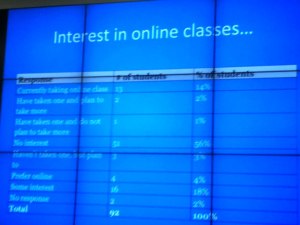
– Jon Morris conducted a survey of students at a Gainesville high school. One of the findings was that 56 percent had no interest in taking online courses.

– Juan Carlos Molleda says, “Online is not for everyone, but it has a great potential and we are looking for that potential.”

– Kim Walsh-Childers — Online courses not only allow students to be somewhere other than Gainesville but allow teachers to be teaching from another location.

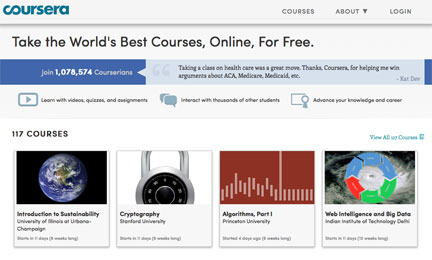
– Judy Robinson talked about Coursera, which offers well-designed courses for free. These courses enable people with a shared interest to come together. The courses that some universities are offering online are great public relations for the university.

– Mike Foley expressed his concern about how he would convey the enthusiasm he shares in a face-to-face class in an online course. Many responses from colleagues about how to use the technology tools to convey enthusiasm.

– Leigh Seaman (Sea2Sea Media) asked us what was driving our interest in online learning — reaching a different audience, generating income?

– Howard Finberg (Poynter) said that the many concerns our faculty are having are issues that faculty are having across the country. But we need to respond to online teaching/learning. Every Florida high school student is required to take at least one online course for graduation. Can we re-imagine how we teach online? We can’t teach online just like we’re currently teaching. This is an opportunity.