Orientation for University of Florida Graduate Teaching Assistants, Aug. 15, 2017

by Julie Dodd

I’m looking forward to being part of the team who will be conducting the Orientation for Graduate Teaching Assistants at the University of Florida.

More than 400 new teaching assistants participate in the orientation each August, and I enjoy helping the TAs begin their teaching careers.

Some have had previous teaching experience, teaching in higher ed or K-12. Some have been guest speakers in a class. But for the majority of those attending the orientation, this is their first teaching experience.

My title of my presentation is “Your Syllabus and the First Week of Class.” I’ve just emailed my slides and handout to those assembling all the materials. The orientation will be on Aug. 15.

4 teaching strategies for college instructors — context, optimism, preparation and engagement

by Julie Dodd

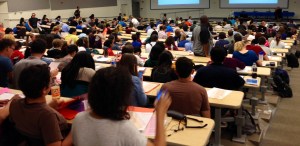
auditorium class

COPE Strategies can help teachers as they begin new academic year.

The start of the school year provides the opportunity for teachers and students to consider the big picture of teaching and learning before getting caught up in the week-by-week view of readings, quizzes and assignments.

Scott Newstok’s “How to Think Like Shakespeare” offers a call to action for the Class of 2020 (and for all college students) to take advantage of the learning enterprise to realize the value of gaining knowledge, to engage in critical thinking, and to seek collaborative environments.

Newstok’s essay, although directed at college students, provides a model for college teachers of how to take lofty student learning outcomes and design classes and assignments to enable students to reach those outcomes.

In speaking at the orientation for new teaching assistants at the University of Florida, I wanted to help those 350+ new instructors consider some big concepts that could help them develop their teaching outlook.

I talked with them about what I call the COPE Strategies to help develop a teaching approach.

Continue reading

Tips from TAs for being successful new teachers

by Julie Dodd

ta-orientation-2016Three teaching assistants who were winners of UF’s Graduate Student Teaching Awards offered teaching advice at the UF TA Orientation.

William Hedderson – Applied Physiology & Kinesiology
Will discussed two topics that I discussed and so did Carla and Michael — promoting active learning and learning students’ names. Teaching doesn’t mean that you need to be lecturing for the full time. Plan class to get students involved and talking with each other. After spending his first semester of teaching learning very few student names, Will made a real effort to learn names, and that made a big difference in his interaction with his students.

Carla Strickland-Hughes – Psychology
Carla talked about how to organize a lecture or presentation, including providing the students an overview at the start of class to help them know their objectives for the class. Other tips included making presentation slides easy to read and helpful with large point size (at least 24 point), relevant images, and not too many words. She recommended building in student activities about every 15 minutes to keep the students engaged. Having a supplemental textbook provides you, as the instructor, additional examples to use in class.

Michael Polo – Music
Michael told the story of how his teaching assignment was the one music area he had most disliked as a student himself — live singing. But he prepared to take on the challenge of teaching a course he had dreaded and wound up being very successful with his students. The take-away — You won’t always be assigned to classes that you enjoyed as a student, but you can become a very effective instructor … if you make the effort.

 

Positive start to your teaching — my advice at UF TA Orientation 2016

UF TA Orientation 2016

I presented a session to more than 400 graduate students who attended the New Teaching Assistant Orientation at the University of Florida. Photo by Bobbi Carpenter

by Julie Dodd

UF TA Orientation 2016

I encouraged the TAs to make the most of their time this week to prepare for the start on classes next wee. Photo by Keir Hamilton

Welcome to the new teaching assistants at the University of Florida. (And welcome to all of you who are new to teaching this semester.)

I appreciated the UF Graduate School and UF Teaching Center inviting me to be on the program for the UF TA Orientation — speaking on “A Positive Start to Your Teaching: Your Syllabus and the First Week of Classes.”

Thanks to the more than 400 teaching assistants in my session for their attention, their involvement, and their questions.

I hope the new TAs will take advantage of the optional sessions being offered:

  • “Teaching for Teaching in UF Classrooms” – Aug. 18, 10 a.m. to noon, Turlington L005
  • “International TAs in UF Classrooms” – Aug. 18, 2 to 4 p.m., Turlington L005
  • “e-Learning@UF: Getting Started, Intermediate & Advanced” – Aug. 19, HUB 221

You can follow me on Twitter – @profdodd

UF Orientation helps new teaching assistants have positive start to semester

UF TA Orientation 2015

More than 350 teaching assistants attend the annual orientation for teaching assistants at the University of Florida. I took this photo from the back of Carleton Auditorium before my session in 2015.

by Julie Dodd

New teaching assistants at the University of Florida will attend an Orientation for Graduate Teaching Assistants on Tuesday, Aug. 18, to help them be ready for the start of Fall Semester on Monday, Aug. 22.

I’ll be one of the speakers on the day-long program, which will be held in Carleton Auditorium.

My session is “Your Syllabus and the First Week of Class.” That broad topic lets me talk about many important aspects of a successful start of the semester — from incorporating active learning activities in class to being sure to have an umbrella.

I’ll post the handout and slides from the presentation.

The orientation is hosted by the UF Graduate School and the UF Teaching Center.

Discussion as a teaching tool — pros, cons and teaching tactics

pair-share in Multimedia Writing

Think-pair-share is one of the strategies to lead to an active class discussion.

As a member of the University of Florida’s Graduate Student Teaching Awards Committee, I have the opportunity to observe teaching assistants in a variety of different subject areas — from entomology to criminology. An important element of many of these classes is class discussion.  

I’ve found that even though the class size may be under 30 and the topic interesting, not every teaching assistant has structured their approach to discussion to get the class involved. I’m reposting Minch Minchin’s helpful specific strategies to promote effective discussion. – Julie Dodd

by Minch Minchin
Ph.D and J.D. student, University of Florida

Minch Minchin

Minch Minchin

Class discussions as a pedagogical tool are as old as teaching, itself.

Yet despite discussion’s rich and ancient lineage, some teachers may be wary of promoting discussions in their classrooms. Such fears are not without merit, as there are practical limitations to discussions as well as the potential for things simply to go wrong:

  • Students may not be prepared and have nothing to say (and silence is often perceived as awkward).
  • If students do all the talking, the teacher may not be able to cover the requisite material.
  • Students may ask questions for which the teacher is unprepared or doesn’t know the answer to.
  • The discussion may become controversial, off topic or out of hand.

Continue reading

4 strategies to prevent academic dishonesty

by Margaret Gaylord
Master’s Student, University of Florida

Margaret Gaylord

Margaret Gaylord

Academic dishonesty has reached epidemic proportions, starting as early as middle school.  Cheating is a complicated problem, not just explained away by a lazy student. The good news is that educators can be a critical part of education and prevention for their students on this subject.

Who Cheats? 

Honors students, weak students, low GPA students, high GPA students, students of color, students who are white, middle class students. In a phrase, all types of students.

We have seen evidence of cheating in places we would not expect: Harvard and the Air Force Academy, to name two. The point is, there is no typical student that can be identified as a chronic cheater. More effectively, instructors can find ways to reduce the incidence of cheating through practical changes in their own classrooms.

Continue reading

More research is needed to back up learning styles theories

by Cindy Spence
Master’s student, University of Florida

Cindy Spence

Cindy Spence

Intuitively, learning styles theory makes sense. Many of us have an orientation toward a certain kind of stimulus: visual, aural, kinesthetic. And many of us believe we learn better if a lesson caters to our orientation.

The evidence, however, says our intuition is wrong.

University of Virginia psychology Professor Daniel Willingham, who studies the role of cognitive psychology in kindergarten through university education, says the evidence for learning styles just does not exist. Learning styles, he says, are one of those things people think they have figured out. They believe science has settled the issue, in favor of learning styles, when very little research has been done at all.

Continue reading

Culturally responsive teaching – A perspective for improving student learning

by Kendra Auguste
Ph.D.  student, University of Florida

Kendra Auguste

Kendra Auguste

Culturally diverse students face additional challenges associated with adjusting to an unfamiliar or predominately white culture. As a result, educational attainment at the collegiate level remains an issue for minority students.

Contributing stressors include:

The imposter syndrome: Students may feel like they aren’t smart enough and question if they belong on a college campus. “Surely the admissions committee made a mistake!” They may struggle with meeting some performance measure or find difficulty fitting in.

First-generation condition: Those students who are the first in their families to attend college may lack family support and find difficulty adjusting to a culture different from their own.

Continue reading

Group project strategies contribute to learning potential for college students

by Daniel Pimentel
Ph.D student, University of Florida

The Parable of Stones: Communicating the Benefits of Group Projects

Daniel Pimentel

Daniel Pimentel

Often considered the holy grail of technology companies, Apple Inc. represents a diverse and interdisciplinary team of professionals. From packaging design specialists to software engineers, the team at Apple is what many would call the ultimate group project based on its roots in a California garage in 1976.

Nearly two decades after his small project revolutionized the way humanity communicated, Apple’s founder and icon, Steve Jobs, spoke on a childhood experience and the importance of teamwork. He described how as a child an elderly man on his block invited him to view his collection of rocks. The man was rugged and aged, and Jobs wondered what value these rocks provided for the man. Placing them in a motorized container filled with liquid and grit powder, the man turned on the machine causing a chorus of clanks and swashes. He invited Jobs back the following morning.

Continue reading