
by Julie Dodd
Teaching online continues to grow as an integral part of college curriculum.
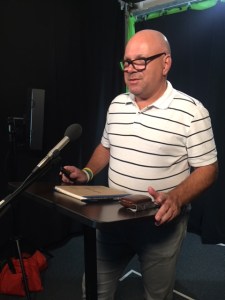
Rob Marino records a video lecture for Writing for Mass Communication. Mario recorded the lectures in the University of Florida’s Center for Instructional Technology and Training.
Almost every college instructor uses some online element even in face-to-face classes. Instructors use course management systems (CMS) to send announcements to their students or to collect and return graded assignments.
Some courses are hybrid or blended, with instructors using online components to replace what would have been conducted in class – giving quizzes or having students work with a partner or team online.
Virtual office hours can be held in an online chat room, giving students the opportunity to ask questions and receive feedback without having to deal with all the logistics involved in going to campus for face-to-face office hours.
If you talk with undergraduate students, many will report having taken at least one completely online course. According to Babson Survey Research Group’s “Online Report Card: Tracking online education in the Unites States,” about 5.8 million college students were taking at least one online course during fall semester 2014, and the number continues to increase.
Rob Marino and I met to talk about our experiences in teaching online. Marino has been teachng online courses at College of Central Florida since 2013 and at the University of Florida for two years. In addition to his class teaching, Marino is the adviser of Patriot Press, the CFC newspaper. Marino was selected as the 2017 Distinguished 2-year Newspaper Adviser by the College Media Association.
I developed the online version of Multimedia Writing for the University of Florida online degree in Public Relations. I had taught face-to-face for a number of years. I received the Online Excellence Education Award for “Instructional Design” in 2017.
I aked Marino to talk about his four years of teaching online courses.
 Strategies for Successful Teaching