Strategies for improving student learning by promoting intrinsic motivation

by Steve Waters
MAMC student, University of Florida

For my presentation, I discussed motivation types among students and some best practices for encouraging intrinsic motivation in the classroom.

One popular theory when thinking of motivation is the attribution theory, which basically states that when a student seeks explanation for unexpected outcomes, they make attributions about probable causes. You can find a well-written overview from Purdue on attribution theory here:

http://education.purduecal.edu/Vockell/EdPsyBook/Edpsy5/edpsy5_attribution.htm

Continue reading

How to Write a Multiple Choice Test: Dos and Don’ts

by Holly Cowart
Ph.D. student, University of Florida

The advantages of multiple choice testing include ease of grading and student familiarity with the format. The disadvantages include the fact that students can guess the correct answers and often aren’t tested on higher-order thinking. The time required to develop a good multiple choice test may not be justified in a small course.

DO’s for creating multiple choice exams

  • Randomize correct answers
  • Use parallel construction (in stem and choices)
  • Adapt, not adopt questions
  • Use application
  • Put most of the words in the stem, not the answer
  • Make the stem clear
  • Provide plausible answer choices
  • Write concise answer options (or at least similar in length)
  • Put your answers in logical order
  • Pretest your questions – Wilbert McKeachie recommends having a skilled test-taker who doesn’t know the material take your test

Continue reading

Strategies for creating university course syllabi

by Julie Dodd

An important part of successful teaching is being able to design an effective course. The foundation of course design is the course syllabus.

In Mass Communication Teaching (MMC 6930), each class member determines an undergraduate communications course to create a syllabus for. Decisions for developing the syllabus include:

understandingbydesignWhat are the Student Learning Outcomes (SLO). Curriculum design and learning theory support determining the big-picture outcomes for the course and letting those guide the course structure and week-by-week instruction and assignments. A very helpful book for this big-picture to small-picture planning is Understanding by Design (Wiggins and McTighe).

How will student learning be assessed. “McKeachie’s Teaching Tips” recommends using several assessment strategies to enable students who have a variety of learning styles to demonstrate what they have learned. Assessment can include quizzes and exams, major papers or projects, team projects, and class participation.

How will the class be structured. A typical course at the University of Florida is three credits and meets three hours each week. The decision is whether the class will meet three times a week for an hour each time, once a week for three hours, or twice a week, meeting for one hour one day and two hours on the other day.

Continue reading

Student evaluations play major role in assessment of teachers in higher education

by Julie Dodd

Evaluation is part of the education process for both students and instructors.

Student evaluations are a major part of evaluating teaching at most colleges and universities.

At UF, students complete Faculty Course Evaluations every semester. The evaluations are to be completed during the last two weeks of the semester. Instructors have access to their evaluations after UF releases student grades after the semester has ended.

The students are asked 15 questions and rate the instructor on a scale of 1 to 5, with 5 being the highest score. (See questions in sidebar.)

Faculty Course Evaluation questions University of FloridaIn addition, students can provide responses to these open-ended questions:

  • Qualities of instructor which contributed to success of the course.
  • Qualities of instructor which hindered success of the course.
  • Opinions of course, including printed materials.
  • Additional comments to improve overall quality of the course.
  • Any other comments.

Continue reading

Change is reality for media education and higher education

NYT story about online educationby Julie Dodd

The need for change is a theme in much of what is being said about and written about higher education.

The need for change was a theme of President Machen’s State of the University Address to the UF Senate on Aug. 22.

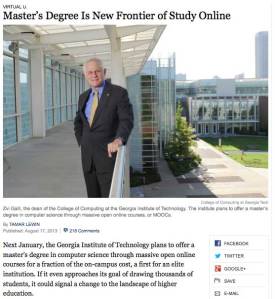
Machen was quoted in this New York Times story about how online education is changing.

The need for change was the theme of the College of Journalism and Communications’ Faculty Kickoff before school started.

For those who are college faculty members and for those who are considering careers in higher education, it’s important to be thinking about what change is and what change means for institutions and individuals.

Continue reading

Presentation for teaching assistants focused on strategies for developing syllabus and having good start to school year

University of Florida orientation for teaching assistants

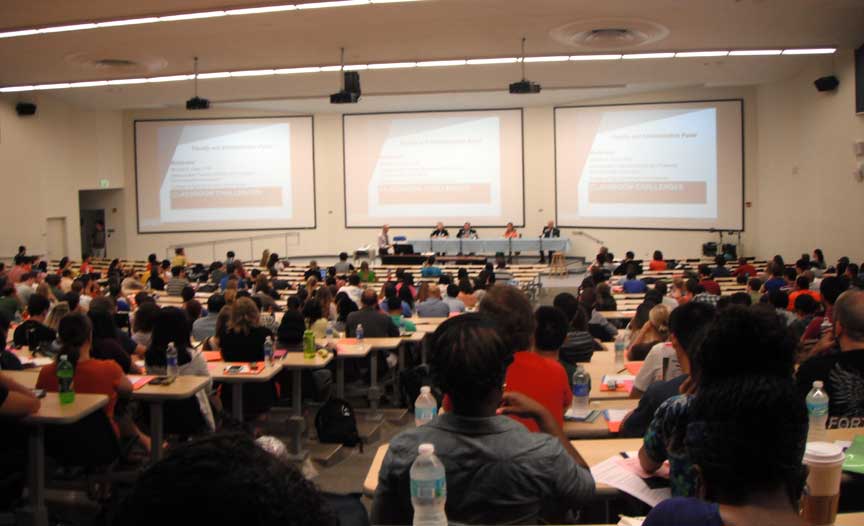
New teaching assistants listen to a panel of faculty members and administrators talk about “Classroom Challenges.” Photo by Julie Dodd

by Julie Dodd

More than 400 teach assistants attended a second day of orientation as they get ready to take on teaching duties when classes start at the University of Florida next week. The orientation is sponsored by the Graduate School and the Teaching Center.

I was one of the invited speakers. My topic was “A Positive Start to Your Teaching: Your Syllabus and the First Week of Classes.” [You can download a PDF handout of the slides I used for my presentation — dodd_2013_ta-orientation]

UF Teaching Assistant HandbookI divided my presentation into several parts:

* Advice about what they should be doing now to get ready for the start of class. That discussion included meeting with their supervisor, getting copies of course materials, and mapping out their own schedule for the semester (including office hours).

* A discussion of how a well-designed syllabus can assist teachers and students. Most of these new teaching assistants won’t be developing the syllabi they will be using this fall, but they need to know what the course policies and procedures are. Thinking more long-term, those who are interested in going into a career of teaching in higher education need to know how to create a syllabus.

Continue reading

8 ideas to remember about classroom discipline

by Anthony Eseke
Ph.D. student, University of Florida

1.     Just as bayberries symbolize discipline and instruction because the berries are held together even in their hundreds, so too discipline connects all the dots of classroom management and pedagogy.

2.     Discipline should be restorative not punitive.

3.     Aspire toward referent power where classroom discipline becomes a product of students’ identification with, respect, and attraction to the personality of the instructor.

4.     Try to understand why students behave the way they do.

Continue reading

Resources for working with students with disabilities

by Hannah Brown
Master’s student, University of Florida

Here are some resources based on my class presentation on working student students with disabilities.

First off, here’s where to find UF’s procedures at the Disability Resource Center: http://www.dso.ufl.edu/documents/drc/DRCInfoGuide.pdf.

Second, here’s the citation for the ethnography on students with learning disabilities that I used in my presentation: 

Stage, F. and Milne, N. (1996) Invisible Scholars: Students with Learning Disabilities. The Journal of Higher Education.  Vol 67 (4). p.426-445.

You can find this article, and the others below, online through JSTOR.

Other resources used:

(2006) Section 504 Online Introductory Tutorial. Florida Department of Education. Retrieved April 14, 2013 from http://sss.usf.edu/504tutorial/Module1/FederalAndStateLaws.html .

Hanafin, J., Shevlin, M., Kenny, M. and McNeela, E. (2007). Including Young People with Disabilities: Assessment Challenges in Higher Education. Higher Education. Vol 54 (3), p. 435-448.

Leuchovius, D. (2003). ADA Q&A… The ADA, Section 504 & Postsecondary Education. Pacer.org. Retrieved April 14, 2013 from http://www.pacer.org/parent/php/PHP-c51g.pdf.

Terman, D., Larner, M., Stevenson, C. and Behrman, R. (1996). Special Education for   Students with Disabilities: Analysis and Recommendations. The Future of Education, Vol. 6(1),  p. 4-24.  

Also, here are a few links to some interesting YouTube videos:

http://www.youtube.com/watch?v=O4f4rX0XEBA

http://www.youtube.com/watch?v=zhzh9kt8z7c

http://www.youtube.com/watch?v=WbLAt2Hc7Rw

Hannah Brown is a student in Mass Communication Teaching (MMC 6930).

How teachers prevent (or promote) academic dishonesty

by Daniel Axelrod
Ph.D. student, University of Florida

A few of the final embers from Harvard’s year-old cheating scandal recently slipped into the ashes when the university revealed that an administrative leak about the incident had been inadvertent.

Ultimately, Harvard forced 60 students to withdraw from school for varying periods of time after they shared answers from a take-home final exam for a class about Congress.

But instead of gawking, it’s worth discussing what teachers can learn to prevent such incidents.

So, Dr. Norm Lewis, a University of Florida journalism professor who studies academic dishonesty, shared with me eight simple solutions for teachers to stop it before it starts:

1.     Be clear about your expectations for academic honesty. At the semester’s start, don’t skip or gloss over the academic dishonesty policies in a syllabus. The first class is the ideal occasion to remind students of the definitions for, and the consequences of, different types of cheating and plagiarism.

2.     Set the right tone. Convey the ideas that good students will be rewarded for effort, and success comes from hard work (not luck or arbitrary judgments by the instructor).

3.     Be there to help your students. True accessibility transcends office hours. From the get-go, let students know they can ask questions and meet with the teacher for feedback.

4.     Lower the stakes. One assignment need not disproportionately count toward a final grade, and students deserve chances to rewrite what they submit. Academic dishonesty is more likely if grade pressures are too high, if students think they can’t handle the work, or if they believe the professor is demanding perfection. So, teachers should adopt attitudes, and institute policies, that prioritize learning over grading.

5.     Prevent last-minute efforts. Leave students ample time to complete assignments, and let them submit work in stages.

6.     Do some detective work. Call or view the students’ sources to see whether they were consulted, if they were properly cited, and to gauge the originality of the submission.

7.     Get to know your students. Besides using a diagnostic assessment to discern students’ creative voices and measure their abilities, simply learning students’ names, and forging real relationships, are the perfect ways to disincentivize/prevent academic dishonesty.

 8.     Close the loopholes. Complete the same tests and assignments given to the students. Consider every crevice, and then start caulking.

Plagiarism and cheating will always exist. But, like students, teachers are accountable for academic dishonesty, too. To ensure academic integrity, the first question an educator should ask is: “Do my practices and priorities prevent or promote it?”

 Daniel Axelrod is a student in Mass Communication Teaching (MMC 6930).